Driving every one of America's designated scenic byways back-to-back takes about 5 to 6 months of continuous driving in 2026, covering the roughly 61,000 miles that make up the 184 routes in the National Scenic Byways program across 48 states. That estimate is pure windshield time — it skips the days most travelers actually want, the ones spent pulling off for overlooks, small-town diners, and the short hikes most byways are built around.
- America's Byways covers 184 designated routes and more than 61,000 miles across 48 states.
- Continuous back-to-back driving takes 5 to 6 months; most travelers spread the full list over years.
- Van life travelers chasing byways full-time typically finish in 2 to 3 years, not months.
- A scenic byway checklist tracker breaks the 184-route list into trip-sized goals instead of one impossible drive.
Why this matters
Most people who set out to drive all of America's scenic byways aren't planning one road trip — they're building a life list. Without knowing the real time cost up front, the plan stalls out somewhere around byway number 12, once the mileage math stops adding up. The breakdown below shows what "all of them" actually costs in time, depending on the pace you're willing to keep.
How long does it take to drive all of America's scenic byways?
The answer changes almost entirely based on pace, not skill or route knowledge. America's 184 scenic byways are spread unevenly across 48 states, so the same total mileage plays out very differently depending on how you sequence the trips.
| Pace | Approx. time to finish | Best for |
|---|---|---|
| Continuous, back-to-back driving | 5-6 months | Sabbaticals, retired RVers, full-time road trippers |
| One or two byways per vacation | 10+ years | Weekend and week-long vacation travelers |
| Van life / full-time travel | 2-3 years | Van lifers, remote workers, long-term travelers |
Continuous driving: 5 to 6 months
If you quit everything and drove every scenic byway back-to-back with no repeat visits and minimal detours, 61,000-plus miles at a realistic byway pace works out to roughly 5 to 6 months on the road in 2026. That number assumes daily driving stretches of 300 to 400 miles, which is generous for roads built around 25 to 45 mph speed limits and frequent pullouts. Almost nobody actually does this — it's the theoretical floor, not a real itinerary.
One byway per road trip: 10+ years
Most travelers knock out one or two byways per vacation, paired with a national park or a regional trip they were already taking. At that rate, finishing all 184 realistically takes 10 years or more, since a typical household gets 3 to 6 road-trip weeks a year and byways cluster unevenly by region. This is the pace that actually works for people with jobs, school calendars, and a mortgage.
Van life full-time: 2 to 3 years
Full-time van life or long-term remote travel compresses the timeline without demanding the 5-to-6-month sprint. Most van lifers who deliberately chase scenic byways as a route strategy finish the full list in 2 to 3 years, because they're already moving constantly and can absorb seasonal closures by simply routing around them.
Why completion time varies
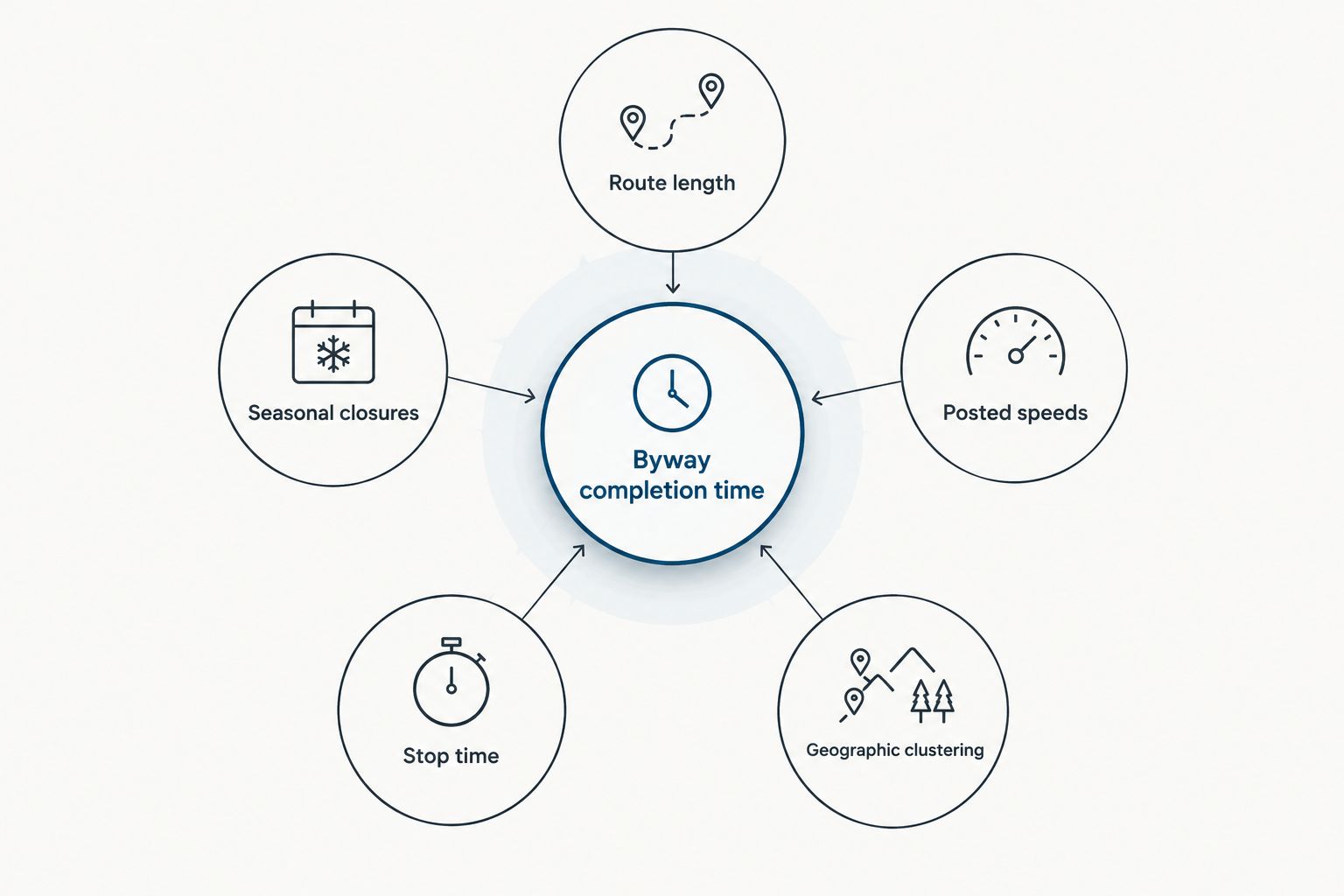
The 5-to-6-month floor is a rough average across 184 very different roads. A handful of factors push real completion time up or down:
- Route length swings wildly. Some byways run 2 to 3 miles through a single town; others stretch past 400 miles across a state.
- Seasonal closures cut the drivable calendar. Mountain byways in Colorado, Montana, and Alaska close for months during snow season, forcing a return trip.
- Posted speeds stay low. Most byways run 25 to 45 mph by design, with pullouts every few miles that slow real progress far below highway pace.
- Stop time doubles drive time. Overlooks, visitor centers, and the small towns most byways route through easily add hours to a route that looks short on a map.
- Byways cluster geographically. The Mountain West, Appalachia, and New England carry a disproportionate share of the 184 routes, so trip sequencing matters more than raw mileage.
Related questions
How many scenic byways are there in the US?
There are 184 designated scenic byways in the US as of the current National Scenic Byways program, spread across 48 states. The exact count and status of individual designations shift periodically, so checking the current list before locking in a route order is worth the five minutes it takes.
Is it possible to drive all of America's scenic byways in one year?
Driving all of America's scenic byways in one year is possible only at the continuous, full-time pace — 5 to 6 months of pure driving still leaves months of buffer inside a calendar year, but only if seasonal closures, work, and life logistics don't get in the way. For anyone not doing this as a dedicated project, a one-year finish isn't realistic.
What's the fastest way to knock out scenic byways on a road trip?
The fastest way to knock out scenic byways on a road trip is to sequence trips by region instead of by byway name, since 184 routes cluster tightly in places like the Blue Ridge, the Pacific coast, and the Rocky Mountain corridor. Mapping a cluster before you drive — rather than chasing one famous byway at a time — cuts wasted backtracking dramatically.
A scenic byway checklist tracker turns that 184-route list into checkable stops grouped by region, so one road trip through Appalachia or the Pacific coast can knock out a dozen byways at once instead of scattering them across unrelated trips over a decade.
Track your byway progress
Grab a printable bucket-list checklist and check off routes as you drive them.
FAQ
How many scenic byways are there in the US?
There are 184 designated scenic byways in the US, spread across 48 states under the National Scenic Byways program. A handful of states have zero designated byways, while others hold a dense cluster.
How long is the total mileage of all scenic byways combined?
The 184 designated scenic byways combine for more than 61,000 miles of road. Individual byways range from a couple of miles to several hundred.
Can you drive all scenic byways in a single year?
Driving all scenic byways in a single year is only realistic at a continuous, full-time pace of 5 to 6 months of straight driving. Most travelers who aren't treating it as a dedicated project take years, not months.
Is it faster to drive scenic byways by region or by state?
Driving scenic byways by region is faster than by state, since the 184 routes cluster in areas like Appalachia, the Rocky Mountains, and the Pacific coast rather than spreading evenly. Regional routing cuts backtracking that state-by-state planning creates.
Do scenic byways close seasonally?
Yes, several scenic byways close seasonally, mainly high-elevation routes in Colorado, Montana, and Alaska that see months of snow each year. Seasonal closures are one of the biggest reasons a full byway list takes years to finish rather than months.
What's the average speed limit on a scenic byway?
Most scenic byways post speed limits between 25 and 45 mph, well below standard highway speeds. The lower limits, plus frequent pullouts, are why raw mileage understates real drive time.
Is a scenic byway road trip good for van life travelers?
A scenic byway road trip works well for van life travelers, since full-time movement lets them absorb seasonal closures by routing around them. Van lifers chasing the full 184-route list typically finish in 2 to 3 years.
How do you track which scenic byways you've completed?
A printable scenic byway checklist tracker is the simplest way to track completed routes, grouping the 184 designated byways by region so progress is visible trip by trip. Marking routes off as you drive them keeps a multi-year project from feeling endless.
One last thing
A good chunk of the 184 scenic byways run through or near national park entrances, so a byway trip and a national parks bucket list overlap more than most planners realize. Sequencing a byway route around a park visit — instead of treating them as two separate projects — is the single biggest time-saver in this whole exercise, and it's the one thing most 2026 road trip plans miss on the first pass.