No federal agency keeps one official count of writers' homes open for tours, but the National Park Service alone runs at least five sites built around individual authors, and state historical societies, universities, and nonprofit trusts operate dozens more across the country in 2026. The hidden catch: many lists blur "home a writer lived in for decades" with "birthplace," "death site," or "campus building where they once had an office," which is why two different sources will never agree on a single total.
- No single registry tracks how many writers' homes are open to the public in the US as of 2026.
- The National Park Service runs at least five home sites tied to individual authors, including Carl Sandburg's and Eugene O'Neill's.
- State historical societies, universities, and nonprofit trusts add dozens more, from The Mark Twain House to Rowan Oak.
- Counts vary because birthplaces, death sites, and campus-owned homes get mixed in with true residence museums.
- A printable checklist tracker is the easiest way to log which ones you've actually walked through.
Why this matters
Ask five literary travel bloggers "how many writers' homes are open to the public" and you'll get five different numbers, because there's no equivalent of the National Register of Historic Places filtered specifically for "author lived here." That's a real planning problem if you're building a road trip around literary landmarks in 2026 rather than just National Parks or MLB stadiums, where the counts are fixed and published.
Collectors tracking this niche do it the same way they track historic homes checklist trackers generally: pick a defined list, work through it, and don't worry about matching some phantom master total. If you want a starting roster instead of chasing a moving number, a writers' homes checklist tracker gives you a fixed set to check off rather than an unanswerable trivia question.
How many writers' homes are open to the public in the US?
Here's a snapshot of well-documented, currently operating writers' homes across regions, the kind that show up on almost every credible literary-travel list in 2026:
| Writer | Home | Location | Managed by | Best for |
|---|---|---|---|---|
| Mark Twain | The Mark Twain House & Museum | Hartford, CT | Nonprofit museum | Victorian architecture fans |
| Edith Wharton | The Mount | Lenox, MA | Nonprofit trust | Garden and design lovers |
| Ernest Hemingway | Hemingway Home & Museum | Key West, FL | Private museum | Beach-trip literary stopovers |
| Emily Dickinson | Emily Dickinson Museum | Amherst, MA | University-run (Amherst College) | Poetry pilgrims |
| Louisa May Alcott | Orchard House | Concord, MA | Nonprofit trust | Family road trips |
| William Faulkner | Rowan Oak | Oxford, MS | University-run (Ole Miss) | Southern literature readers |
| Carl Sandburg | Carl Sandburg Home NHS | Flat Rock, NC | National Park Service | History-plus-poetry combo trips |
| Eugene O'Neill | Tao House | Danville, CA | National Park Service | Reservation-only tour planners |
That's eight confirmed, currently touring homes just from a handful of major regions, and it barely scratches the full roster once you add regional literary societies and smaller state-run sites.
National Park Service sites: at least five writers' homes
The NPS is the most citable anchor for this question because its unit list is public and stable. Five home sites built around individual authors currently operate under NPS management in 2026:
- Carl Sandburg Home National Historic Site — Flat Rock, North Carolina
- Eugene O'Neill National Historic Site (Tao House) — Danville, California
- Edgar Allan Poe National Historic Site — Philadelphia, Pennsylvania
- Longfellow House–Washington's Headquarters National Historic Site — Cambridge, Massachusetts
- Frederick Douglass National Historic Site — Washington, D.C.
Verdict: visit all five if you're building an NPS-anchored literary road trip — they're the only writers' homes with guaranteed year-round federal maintenance and staffing standards behind them.
State, university, and nonprofit sites: dozens more
Outside NPS boundaries, the count opens up fast. State historical societies run homes like Willa Cather's childhood house in Red Cloud, Nebraska. Universities maintain author homes as living classrooms — Rowan Oak belongs to Ole Miss, the Emily Dickinson Museum belongs to Amherst College. Independent nonprofits run some of the most-visited sites on this list, including The Mark Twain House, The Mount, and Louisa May Alcott's Orchard House.
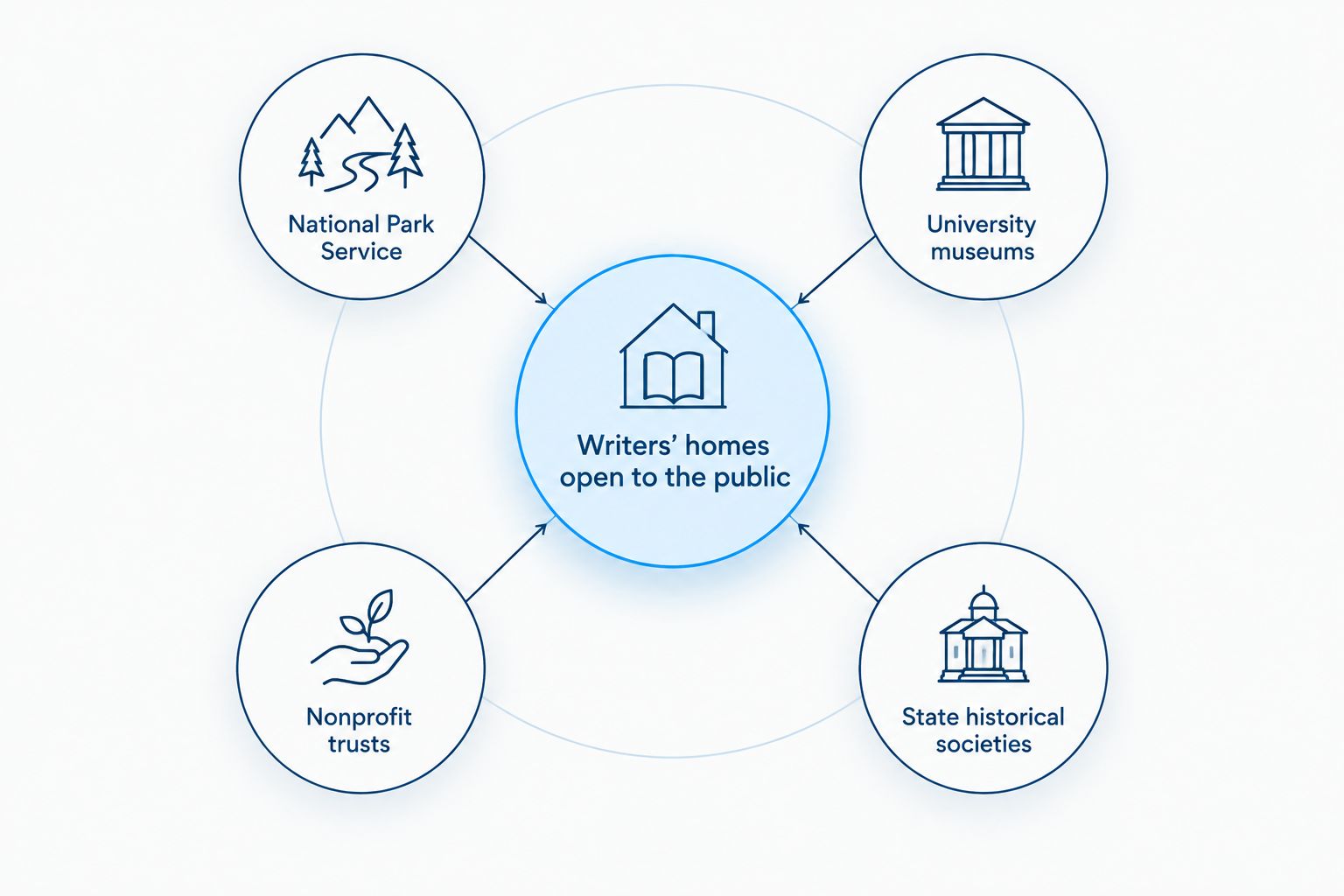
Add private museums (Hemingway Home & Museum operates as a for-profit historic attraction) and you've got five distinct ownership models feeding into one loosely defined category, none of which report to a shared national count.
Why the count varies so much
- No federal or ALA-style master registry exists specifically for "author residence museums." Lists get compiled by bloggers, regional tourism boards, and literary societies independently.
- Birthplaces and death sites get counted alongside actual long-term homes. A house where a writer was born but never returned to is a different visit than a home they wrote in for 30 years.
- University-owned homes sometimes get filed as "campus attractions" rather than house museums, which drops them out of tourism-board lists entirely.
- Seasonal and by-appointment-only sites cycle in and out of public databases depending on funding and staffing each year.
- Regional literary societies keep their own lists that don't sync nationally — a home celebrated in a New England literary trail guide may never appear in a national ranking.
- New sites open and older ones close as preservation trusts gain or lose funding, so any fixed number goes stale within a year or two.
Track your writers' homes visits
A printable checklist for the homes you've actually walked through, no master registry required.
How many Frank Lloyd Wright buildings are open to the public?
That count works the same way — no single agency tracks it, but the Frank Lloyd Wright buildings open to the public guide breaks down the confirmed, currently touring sites the way this page does for authors' homes.
Is the Mark Twain House still open in 2026?
Yes, The Mark Twain House & Museum in Hartford, Connecticut, operates as an active nonprofit museum in 2026 and remains one of the most-visited writers' homes in the country. It's the most frequently cited example on nearly every regional literary-travel list.
What's the best way to track which writers' homes you've visited?
A fixed checklist beats chasing a moving national total, since the exact number of writers' homes open to the public shifts as sites open, close, or change hands. A printable checklist lets you log visits against a defined roster instead of an unanswerable trivia question.
FAQ
How many writers' homes are open to the public in the US in 2026?
There's no single official count, but at least five are run by the National Park Service, and dozens more operate under state historical societies, universities, and nonprofit trusts nationwide in 2026.
Which writers' homes are run by the National Park Service?
Five NPS sites are built around individual authors: Carl Sandburg Home, Eugene O'Neill's Tao House, Edgar Allan Poe National Historic Site, Longfellow House, and Frederick Douglass National Historic Site.
Is The Mark Twain House open to visitors?
Yes, The Mark Twain House & Museum in Hartford, Connecticut, is an active nonprofit museum open for tours in 2026.
Why don't sources agree on how many writers' homes exist?
Lists mix birthplaces, death sites, and campus-owned homes with true residence museums, and no national registry tracks the category, so counts vary by source.
Are university-owned writers' homes open to the public?
Yes, homes like William Faulkner's Rowan Oak at Ole Miss and the Emily Dickinson Museum at Amherst College are open for public tours despite being university-owned.
Do all writers' homes charge for tours?
Most nonprofit and private house museums require paid admission, while some NPS sites and university-run homes offer free or donation-based entry; check each site directly for current 2026 details.
What's the difference between a writer's home and a literary landmark?
A writer's home is a physical residence the author lived in, while a literary landmark can include birthplaces, gravesites, or locations mentioned in their work without any residence involved.
One last thing
The five NPS-run writers' homes are the only sites on this list guaranteed to follow federal preservation standards and consistent seasonal hours — every other home on a literary road trip runs on its own nonprofit, university, or state budget, so always confirm hours before you drive out in 2026.