More than 20 presidential homes and birthplaces are preserved as National Park Service sites open to visitors in 2026, and dozens more operate as private house museums or state historic sites outside the NPS system. The catch: a handful of surviving presidential homes remain privately owned with no regular public tours, and several NPS sites cut hours or close entirely during winter months.
- More than 20 presidential historic homes are open to visitors in 2026 as National Park Service sites.
- Private foundations run additional stops, including Mount Vernon, Monticello and The Hermitage.
- Adams National Historical Park in Quincy, Massachusetts covers two presidents' homes on one property.
- A few homes, including John Tyler's Sherwood Forest, remain private residences without regular public tours.
Why This Matters
Presidential homes are one of the fastest-growing bucket-list categories for history-minded travelers, right alongside ballparks, lighthouses and national parks. Every home tells a different story: George Washington's working plantation at Mount Vernon, Harry Truman's modest Independence, Missouri farmhouse, Lyndon Johnson's ranch on the Pedernales River. Collectors who already track ballpark visits or state park counts are doing the same with presidential sites, checking off each stop the way baseball fans log every MLB stadium.
The trouble is there's no single official list. The National Park Service runs one set of sites, private foundations run another, and state historical societies run a third. A historic homes checklist tracker solves the sorting problem before you're stuck sorting it out on a road atlas in 2026.
How Many Presidential Historic Homes Are Open to Visitors?
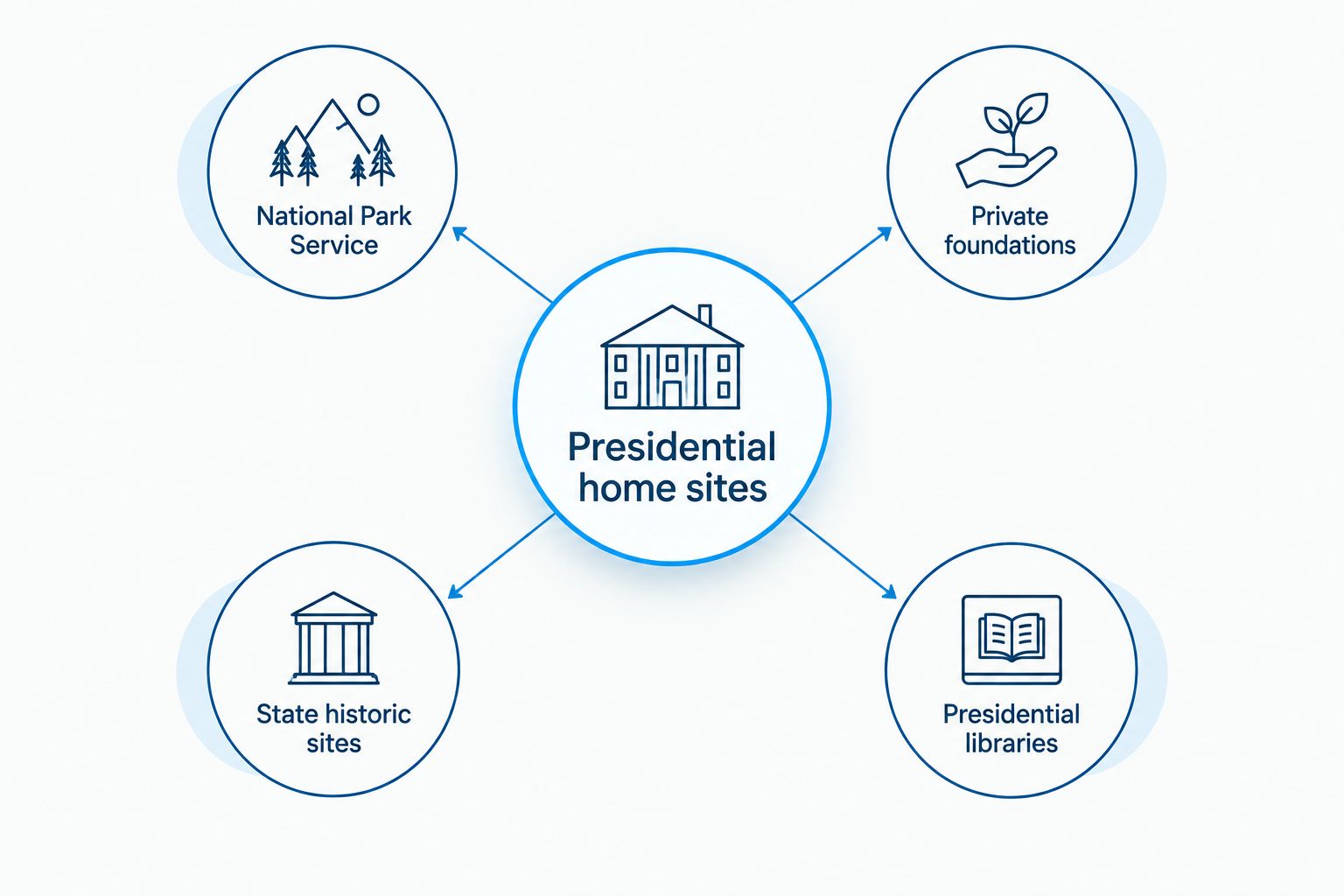
Presidential home sites fall into four management categories, and each one comes with its own hours, fees and access rules. Here's how the roughly 20-plus federal sites stack up against the private and state-run homes that fill out the rest of the list.
| Site type | Example homes | Who manages it | Best for |
|---|---|---|---|
| National Park Service sites | Sagamore Hill, Adams National Historical Park, LBJ Ranch | National Park Service | Collectors who want a stamped passport book |
| Private foundations | Mount Vernon, Monticello, Montpelier, The Hermitage | Independent nonprofits | Deep house-museum tours with guided interiors |
| State historic sites | Spiegel Grove, Coolidge Homestead | State governments and historical societies | Regional stops on a road trip |
| Presidential libraries | Reagan Library, Clinton Presidential Center | National Archives (NARA) or private foundations | Records and exhibits, not the actual residence |
NPS-Administered Presidential Homes: More Than 20 Sites
The National Park Service manages the largest single block of presidential homes open to visitors in 2026, including:
- Adams National Historical Park (Quincy, MA) - covers "Peacefield," the shared home of John Adams and John Quincy Adams.
- Sagamore Hill National Historic Site (Oyster Bay, NY) - Theodore Roosevelt's summer White House.
- Home of Franklin D. Roosevelt National Historic Site (Hyde Park, NY) - Springwood, FDR's family estate.
- Harry S. Truman National Historic Site (Independence, MO) - the Trumans' family home after the White House.
- Eisenhower National Historic Site (Gettysburg, PA) - the only home Dwight and Mamie Eisenhower ever owned.
- Lyndon B. Johnson National Historical Park (Stonewall/Johnson City, TX) - the LBJ Ranch, still called the "Texas White House."
- Herbert Hoover National Historic Site (West Branch, IA) - Hoover's birthplace cottage.
- William Howard Taft National Historic Site (Cincinnati, OH).
- Martin Van Buren National Historic Site (Kinderhook, NY) - Lindenwald.
- James A. Garfield National Historic Site (Mentor, OH) - Lawnfield.
- Jimmy Carter National Historical Park (Plains, GA) - added the Carter family's boyhood farm to the federal roster in recent years.
Verdict: if you only chase the federal sites, you'll clear more than 20 homes across a dozen states, and you'll earn a stamp in the NPS passport book at nearly every stop.
Private and State-Run Presidential Homes: Dozens More Stops
Outside the NPS system, private foundations and state historical societies preserve just as many presidential homes, and some are the most-visited sites in the entire category:
- Mount Vernon (Fairfax County, VA) - George Washington's plantation, run by the Mount Vernon Ladies' Association since 1860.
- Monticello (Charlottesville, VA) - Thomas Jefferson's estate, run by the Thomas Jefferson Foundation.
- Montpelier (Orange, VA) - James Madison's home, run by the Montpelier Foundation.
- The Hermitage (Nashville, TN) - Andrew Jackson's estate.
- Spiegel Grove (Fremont, OH) - Rutherford B. Hayes's home, paired with his presidential library on the same grounds.
- Wilson House (Washington, DC) - Woodrow Wilson's retirement home, run by the National Trust for Historic Preservation.
- Warren G. Harding Home (Marion, OH) - run by the Ohio History Connection.
- Wheatland (Lancaster, PA) - James Buchanan's estate.
“If a president's home survives at all, it's usually because a private foundation raised the money to save it long before the National Park Service ever got involved.”
Why the Count Varies
- Definition of "home" - a birthplace cottage counts differently than a working plantation or a retirement house, and some presidents left several behind.
- Private ownership - descendants of John Tyler still hold Sherwood Forest, and it isn't set up for regular public tours.
- Seasonal hours - rural NPS sites like the LBJ Ranch trim visiting hours in winter months.
- Shared properties - Adams National Historical Park checks two presidents off a list with a single visit.
- Recent redesignations - Jimmy Carter's boyhood farm only became a National Historical Park in the 2020s, so the federal roster keeps growing year over year.
- Lost homes - fires and demolition mean a few early presidents have no surviving residence left to tour at all.
Track Every Home You Visit
Sort NPS, private and state presidential sites into one printable list.
More Presidential Home Questions
Is Mount Vernon a presidential historic home?
Yes, Mount Vernon in Fairfax County, Virginia is George Washington's plantation home, and it's one of the most-visited presidential sites in the country. It's run by the private Mount Vernon Ladies' Association rather than the National Park Service, so it sits outside the roughly 20-plus federal presidential sites.
Are presidential libraries the same as presidential homes?
No, presidential libraries mainly hold records, artifacts and museum exhibits rather than serving as the president's actual residence. A few, like Spiegel Grove in Ohio, sit on the same grounds as the home itself, but most modern libraries, including the Reagan and Clinton facilities, are standalone campuses built after the president left office.
Can you visit every presidential home in one road trip?
Not in one trip. The homes span from Massachusetts to Texas to Iowa, and a number of homes and libraries close on set days or entire seasons, so most collectors work through the list region by region across several trips in 2026 and beyond.
FAQ
How many presidential historic homes are open to visitors in 2026?
More than 20 presidential homes and birthplaces operate as National Park Service sites in 2026, and dozens more run as private house museums or state historic sites. A few homes, like John Tyler's Sherwood Forest, remain private with no regular public tours.
Is Mount Vernon a presidential historic home?
Yes, Mount Vernon is George Washington's Virginia plantation, run by the private Mount Vernon Ladies' Association rather than the National Park Service.
Are presidential libraries the same as presidential homes?
No, presidential libraries mostly hold records and museum exhibits rather than serve as a residence, though a few sit on the same property as the home itself, like Spiegel Grove in Ohio.
Which presidential home is free to visit?
NPS-run homes like Sagamore Hill and the Truman Home typically don't charge separate admission, while private estates such as Monticello and The Hermitage charge a fee to fund their upkeep.
Can you visit every presidential home in one trip?
Not realistically. The homes stretch from Massachusetts to Texas to Iowa, and several close seasonally, so most collectors work through the list over multiple road trips.
Which presidents have no home open to the public?
A handful of early presidents, including Franklin Pierce, have no surviving preserved residence, and John Tyler's Sherwood Forest remains a private family home without regular tours.
What's the easiest presidential home to visit near a major city?
Adams National Historical Park in Quincy, Massachusetts sits a short train ride from Boston, and Sagamore Hill on Long Island is an easy day trip from New York City.
One Last Thing
Adams National Historical Park is the closest thing to a two-for-one in this entire category: one ticket, one property, two presidents checked off your list. The same "how many are open" math shows up across other hobbies too - the count of Frank Lloyd Wright buildings open to the public shifts from year to year for the same reason presidential homes do: some structures stay in private hands.