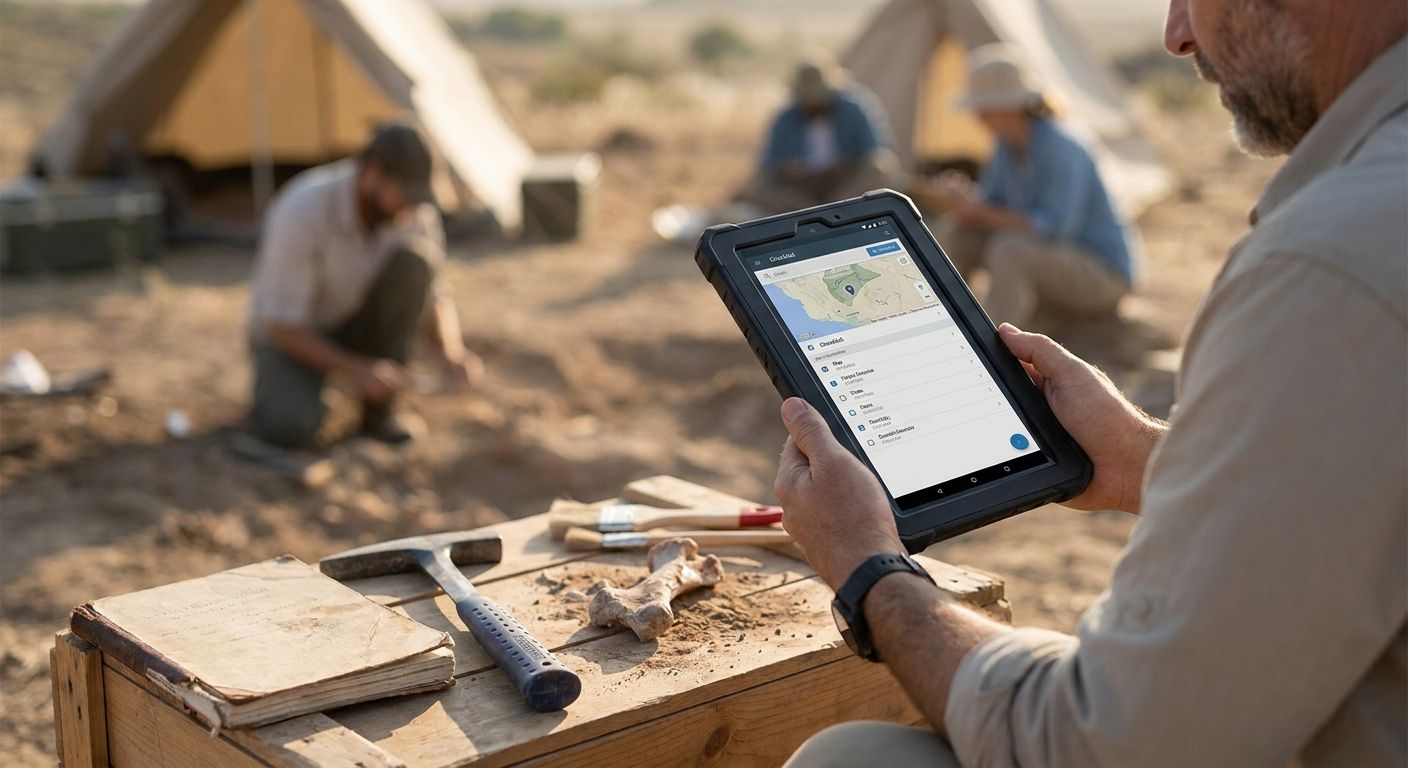
Ranking six ways to track dinosaur and paleontology site visits in 2026, from printable checklists to citizen-science apps, so you know which one to start filling in this weekend.
- The best dinosaur paleontology checklist tracker in 2026 is a printable passport-style checklist — works offline, needs no app, and doubles as a keepsake.
- National Park Service Junior Paleontologist booklets are the strongest free option for family trips to fossil-bearing parks.
- iNaturalist logs GPS coordinates automatically but isn't built as a site checklist — use it alongside a tracker, not instead of one.
- Spreadsheets win on customization; Notion and Evernote win on cross-device sync.
- A travel journal beats every app for narrative detail but offers zero built-in structure.
Why this matters
Dinosaur tourism isn't confined to one museum trip anymore. Between Dinosaur National Monument on the Colorado-Utah border, Dinosaur Ridge outside Denver, the Wyoming Dinosaur Center, the Museum of the Rockies in Bozeman, and heavyweight halls like the Field Museum, the American Museum of Natural History, and the Smithsonian's National Museum of Natural History, a serious fossil-hunting bucket list stretches across a dozen states.
Many of those stops sit inside state park checklist trackers territory as much as national park territory — fossil beds don't respect jurisdiction lines. Without a system, it's easy to forget which tracksite you've already walked and which museum hall you skipped last time.
A printable checklist works the same way Triptyka's national park and lighthouse checklists do: one page, one checkbox per site, a date field, done. No account, no app permissions, no signal required at a fossil bed three hours from the nearest town.
What makes the best paleontology checklist tracker
- Coverage of major fossil parks, dig sites, and natural history museums, not just the famous handful
- Offline usability — most tracksites and canyon museums have zero cell signal
- Low setup effort — you should be tracking in minutes, not building a database
- Keepsake value — something worth framing or handing down once it's filled in
- Kid-friendliness for family paleontology trips
At a glance
| Method | Best for | Standout feature | Key limitation |
|---|---|---|---|
| Printable passport checklist | Gamified bucket-list tracking | Physical, frameable keepsake | No GPS or auto-updates |
| DIY spreadsheet (Sheets/Excel) | Free, fully custom tracking | Unlimited custom columns | Requires building from scratch |
| NPS Junior Paleontologist booklet | Family trips with kids | Ranger-led badge activities | Covers NPS units only |
| iNaturalist | Citizen-science fossil logging | Community species ID | Not built as a visit checklist |
| Notion or Evernote | Cross-device digital tracking | Syncs phone to desktop instantly | Steeper setup than a checklist |
| Travel journal or logbook | Detailed narrative notes | Room for sketches and observations | No built-in checklist structure |
1. Printable Paleontology Passport Checklist: best for gamified bucket-list tracking
A printable passport-style checklist lists dinosaur museums, fossil parks, and tracksites as checkboxes you fill in with a visit date — the same format used across bucket-list categories like lighthouses and national parks. It behaves like a stamp book: no login, no signal, no app update required at a remote quarry.
Printable passport checklist pros:
- One-time download, print at home, no subscription to manage
- Works fully offline, including at fossil beds with no cell service
- Becomes a display-worthy keepsake once filled in
Printable passport checklist cons:
- No automatic GPS check-in or visit reminders
- Manual updates only — you have to remember to fill it in
- No dedicated field for species or rock formation notes
Best for: travelers who want a physical, no-tech way to gamify visits to dinosaur museums and fossil parks. Verdict: Buy.
2. DIY Spreadsheet Tracker: best for free, fully custom tracking
Google Sheets or Excel lets you build your own columns — site name, state, geologic formation, admission notes — and it updates instantly across any device signed into the account.
Spreadsheet tracker pros:
- Free and infinitely customizable
- Sorts and filters by state, era, or visit date
- Shareable with a travel partner in real time
Spreadsheet tracker cons:
- Requires building the site list yourself from scratch
- Easy to abandon without built-in structure or gamification
Best for: spreadsheet users who want granular control over categories like geologic era or admission notes. Verdict: Buy — if you already live in spreadsheets.
3. National Park Service Junior Paleontologist Booklet: best for family trips with kids
More than 400 units of the National Park Service run Junior Ranger-style booklet programs, and several parks tied to fossil beds — including Dinosaur National Monument — issue paleontology-specific booklets kids complete on-site for a badge. If your list overlaps heavily with national park checklist trackers, this pairs naturally with a broader park checklist.
NPS booklet pros:
- Ranger-verified, hands-on activities built for children
- Free at the visitor center
- Turns a museum stop into an active scavenger hunt
NPS booklet cons:
- Covers National Park Service units only — not private museums like the Field Museum
- Booklets vary park to park; there's no single national checklist
Best for: parents tracking family visits to fossil-bearing national parks and monuments. Verdict: Buy for NPS stops, pair with another tracker for museums.
4. iNaturalist: best for citizen-science fossil logging
iNaturalist, the citizen-science app backed by the California Academy of Sciences and National Geographic, lets users log field observations with photos and GPS coordinates that a global community helps identify.
iNaturalist pros:
- Free, with a large community of amateur and professional identifiers
- Logs exact GPS coordinates automatically
- Contributes real observation data to research databases
iNaturalist cons:
- Built for live organisms and field specimens, not museum exhibits behind glass
- Not designed as a "visited sites" checklist
Best for: hobbyists who find their own fossils in the field and want expert identification. Verdict: Hold — a strong tool, but the wrong shape for a site checklist.
5. Notion or Evernote: best for cross-device digital tracking
Both apps sync notes, photos, and checklists across phone, tablet, and desktop, so a list started at the Field Museum updates instantly on a laptop back home.
Notion/Evernote pros:
- Syncs automatically across every device
- Supports photos, links, and embedded maps per entry
- Searchable once the list grows past a dozen sites
Notion/Evernote cons:
- Steeper setup than a printed checklist — templates take real time to build
- Needs prior sync or signal to update at remote sites
Best for: digital-first travelers already organizing trips inside a notes app. Verdict: Hold — solid if you're already in that ecosystem.
6. Travel Journal or Logbook: best for detailed narrative notes
A physical notebook trades checklist structure for open space — sketches of trackways, notes on rock formations, full paragraphs about a guided dig-site tour.
Travel journal pros:
- Unlimited room for sketches, quotes, and observations
- No battery, no signal, no app required
- Becomes a personal travel narrative, not just a list
Travel journal cons:
- No built-in checklist structure — easy to lose track of what's left
- Slower to scan than a table of checkboxes
Best for: travelers who value narrative memory-keeping over a scannable list. Verdict: Skip if speed and structure matter more than storytelling.
Start Your Own Bucket-List Checklist
Browse printable passport-style checklists for travel and hobby bucket lists.
How we ranked these
Each method got scored against the five criteria above: coverage, offline usability, setup effort, keepsake value, and kid-friendliness. The printable passport checklist wins on offline use and keepsake value but loses points on coverage depth for serious species-level trackers, which is why iNaturalist and spreadsheets stay in the mix as complements rather than replacements.
Which paleontology checklist tracker should you choose?
If you want one system that just works at a remote fossil bed with zero signal, the printable passport checklist is the 2026 default. Pair it with an NPS Junior Paleontologist booklet if kids are coming along, or a spreadsheet if you want to slice the data by geologic era. Save iNaturalist for the days you're hunting your own fossils rather than touring someone else's collection. Stringing dig sites together on a road trip pairs naturally with scenic byway checklist trackers for the drive between them.
FAQ
What's the best dinosaur paleontology checklist tracker in 2026?
A printable passport-style checklist is the best overall option in 2026 because it works offline at remote fossil beds and needs no app or login. Pair it with an NPS Junior Paleontologist booklet for kids or a spreadsheet for detailed era tracking.
Is a printable checklist better than an app for tracking dinosaur museum visits?
For remote fossil sites, yes — printable checklists work with zero cell signal, while apps like iNaturalist or Notion need a connection to sync. Apps win for photo logging and GPS coordinates when signal is available.
Does the National Park Service have a junior paleontologist program?
Yes, several National Park Service units tied to fossil beds, including Dinosaur National Monument, run Junior Paleontologist or Junior Ranger booklet programs kids complete on-site for a badge. More than 400 NPS units run some version of the broader Junior Ranger program.
Is iNaturalist good for logging fossil finds?
iNaturalist is strong for identifying and logging field specimens with GPS-tagged photos, backed by the California Academy of Sciences and National Geographic. It isn't built as a visited-sites checklist, so use it alongside a tracker rather than instead of one.
Can I track dinosaur museum visits without a smartphone?
Yes — a printable checklist or a physical travel journal requires no phone, app, or account. Both work entirely on paper and hold up fine at sites with no cell service.
Are there checklists for specific dig sites like Dinosaur National Monument?
General paleontology bucket-list checklists cover major named sites like Dinosaur National Monument alongside museums such as the Field Museum and the Smithsonian. Site-specific NPS booklets are handed out at individual visitor centers.
What's the easiest way to start a dinosaur checklist tracker in 2026?
Print a passport-style checklist and fill in your first visit date this weekend. It takes less setup time than building a spreadsheet or learning a new app.
One last thing
SUE, the Field Museum's Tyrannosaurus rex, is roughly 90% complete by bone count — one of the most complete T. rex skeletons ever recovered, which makes the Field Museum close to a mandatory checkbox on any serious 2026 paleontology list, whichever tracker you land on.