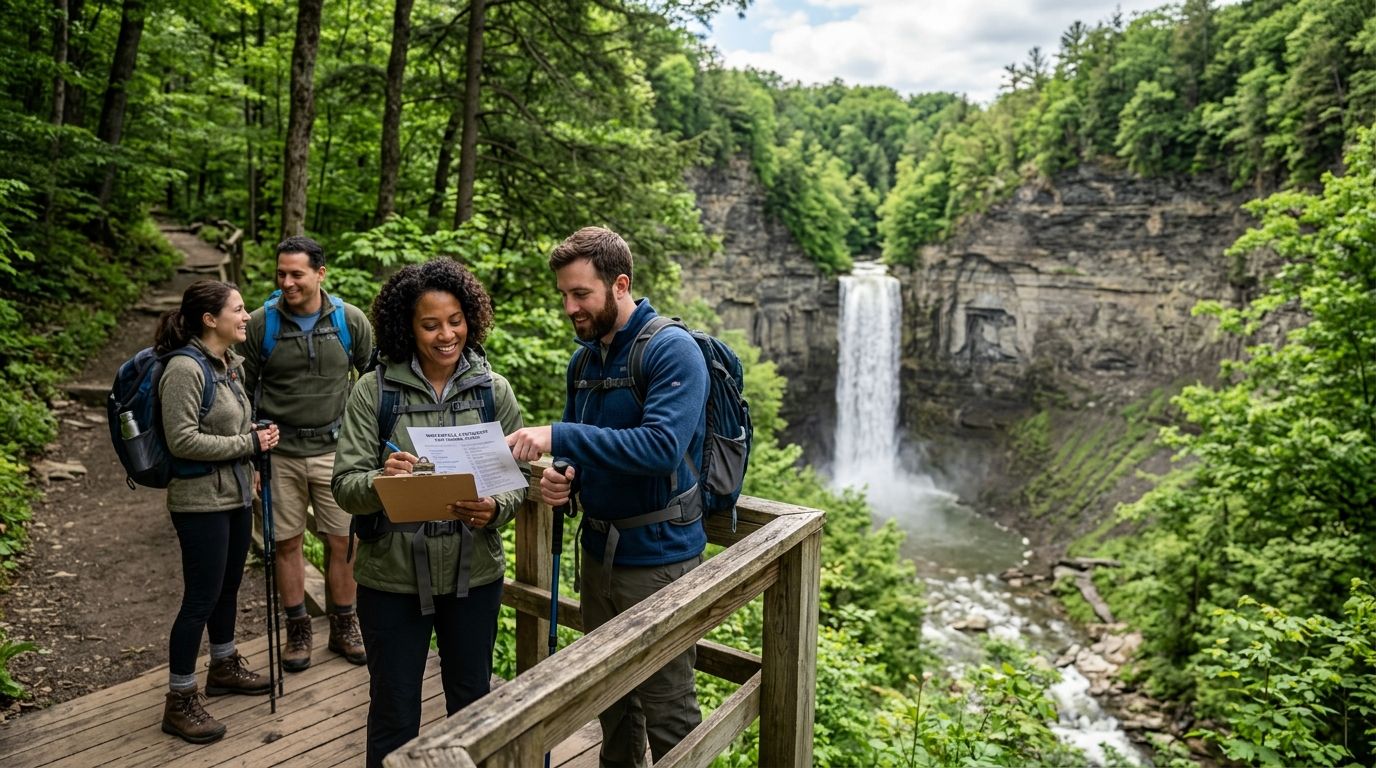
Waterfall checklist for hiking clubs is a shared, printable roster of named waterfalls a club commits to reaching together, built to keep group outings organized and give every member the same way to log the falls the club has actually hiked. Clubs need something a solo tracker never delivers: one list everyone can print, a running count that belongs to the group, and enough trail detail that a leader can plan a route for six different fitness levels without guessing.
- A waterfall checklist for hiking clubs works best as one shared printable roster, not individual app logins.
- Flow season and elevation gain matter more for clubs than for solo hikers planning their own pace.
- Triptyka makes printable bucket-list passports for collectors who want one identical page per member.
- Cap the first-season list at 20-30 falls so completion stays reachable in 2026.
- Name one list owner per season or the checklist dies after the third meetup.
Why a waterfall checklist matters for hiking clubs
A solo hiker can track waterfalls however they like. A club of twelve to forty people cannot — twelve different logging methods produce zero shared record of what the group has done together, and no way to answer the only question members actually ask: how many are left?
Waterfalls also carry a variable that ballparks, breweries and golf courses don't. Flow changes by season. A falls that stops people in their tracks in April can be a damp rock face by late August, and a checklist that ignores that sends half the group home disappointed. Any club roster worth printing carries peak-flow months next to the falls name.
Then there's the newcomer problem. Someone who joins in the club's third year needs to see, on one page, what has already been checked off and what's still open. A group chat scrolled back 400 messages doesn't do that. A printed roster does it in four seconds at the trailhead.
Build a waterfall checklist your hiking club will actually finish
Define the geographic scope first
Start narrow. Clubs that try to track every waterfall across five states end up with a list nobody finishes and nobody references by June.
- Pick one radius the club genuinely drives to: a state, a national forest, or a single mountain range
- Cap the first-season list at 20-30 falls so completion feels reachable
- Split "drive-up" falls from "hike-required" falls so trip leaders can plan around member ability
- Note which falls sit inside a park boundary versus public land with different access rules
- Leave 3-5 slots open for member suggestions, so the list feels shared rather than handed down
Research access difficulty and flow season per falls
This is the step most clubs skip and the one that causes the most trip-day friction. Two waterfalls twenty minutes apart can demand wildly different days out — one a short paved boardwalk, the next a steep round trip with serious elevation gain.
- Log round-trip mileage and elevation gain for every falls on the list
- Record peak-flow months separately from foliage or wildflower timing
- Flag any falls with permits, timed entry, or seasonal road closures
- Record parking lot size, because a small pull-off becomes a real problem for a 15-car caravan
- Mark falls with no cell coverage so leaders know to print directions before leaving
Standardize one club roster format
Every member should be checking off the same falls in the same order with the same notes. This is where a shared printable format beats a group chat full of screenshots and three competing spreadsheets.
- Assign one master format for the whole club and stick with it through the season
- Add a column separating "visited as a club" from "visited solo" so group totals stay honest
- Keep a notes line per falls for trail conditions reported by the last group through
- Number the falls, so members can reference them quickly during planning calls
- Resist reformatting mid-season; a format change resets everyone's sense of progress
Assign one person to own the list
Someone has to own the master copy or the checklist quietly dies. Clubs that keep a waterfall roster alive for more than a season almost always have a single named person — usually the trip coordinator — responsible for updates.
- Name one list owner per season, not a rotating volunteer
- Update the master copy within 48 hours of each group hike, while conditions are fresh
- Reissue printed copies every 3-4 outings rather than after every single trip
- Publish a plain running count: falls visited as a club in 2026 versus falls remaining
Schedule hikes around flow conditions, not calendar gaps
A club that plans purely around member availability ends up hiking to dry rock in high summer. Clubs that get this right build the season backwards from flow windows, then fit availability into that frame.
- Cluster snowmelt-fed falls into early-season trips
- Save reliable spring-fed falls for the driest months of the year
- Check regional precipitation the week before a trip, not the month before
- Build one backup falls into every trip plan in case the primary is running thin
- Repeat one marquee falls annually at peak flow, so newer members aren't shut out
Print and distribute passports for the season
A phone app is a fine personal backup, but it fails the moment a trailhead has no signal — which describes most remote falls. Paper survives rain, drops and dead batteries, and it's the version members actually fill in on the spot instead of "later, at home."
This is where a hand-curated printable checklist does more work than a spreadsheet tab nobody opens between meetups. Triptyka builds downloadable bucket-list passports for exactly this kind of collector-hobbyist tracking: one file, printed as many times as the club needs, identical page in every member's pocket. Honest limitation — a printable means a print run each season and no automatic sync, so the list owner still reconciles by hand.
Turn the roster into a club challenge
Clubs that gamify the list get better repeat turnout than clubs tracking for the sake of tracking. Badges, year-end recognition and a visible count all work.
- Set a season goal, such as visiting 12 of 25 falls before October 2026
- Recognize members who complete the full list at the year-end meeting
- Rotate a featured "falls of the month" hike to keep the list moving
- Pair falls visited with long-distance hiking trail mileage for members chasing both goals
- Post the club count somewhere members see it monthly, not just at renewals
“If the trailhead has no signal, your tracking method is paper whether you planned for that or not.”
Comparison: waterfall tracking options for hiking clubs
| Option | Best for | Key limitation |
|---|---|---|
| Shared spreadsheet | Clubs with a dedicated list owner and spreadsheet-comfortable members | No offline access at trailheads without signal |
| General hiking app | Individual members logging personal mileage | No shared club view; each member's data stays siloed |
| Free printable template | Clubs wanting a fast, zero-cost starting point | No waterfall-specific fields for flow season, parking or coverage |
| Waterfall checklist tracker | Clubs that want one identical offline roster with waterfall detail built in | Needs a fresh print run each season; no auto-sync |
| Wall map with pins | Clubhouses and meeting spaces displaying group progress | Doesn't travel; members can't carry it to the trail |
Verdict: for a hiking club of any size in 2026, a printed waterfall checklist beats app-based tracking, because it works with zero signal and puts an identical reference page in every member's hands. Apps are a supplement, not the club record.
Get a printable waterfall passport
One roster every club member can carry to the trailhead, signal or not.
Common mistakes hiking clubs make with waterfall checklists
- Tracking by individual app instead of a shared roster. The club finishes 2026 with no combined record of what the group actually did together, only fragments on individual phones.
- Ignoring flow season when scheduling. A midsummer trip to a snowmelt-fed falls turns a multi-mile hike into a walk to a wet cliff, and newer members don't come back.
- Skipping difficulty notes for mixed-ability groups. A club spanning casual walkers and trail runners needs mileage and elevation gain logged per falls, not assumed from memory.
- Letting the master copy go stale. A roster six months out of date stops functioning as a planning tool and becomes a scrapbook.
- Assuming cell coverage. Remote falls sit outside service far more often than the parks and stadiums most bucket lists cover, which is exactly why printed backups matter more here.
FAQ
What's the best waterfall checklist for hiking clubs in 2026?
A shared printable roster with flow-season and mileage notes is the best format for clubs, because it works at no-signal trailheads and gives every member an identical page. Solo app trackers don't solve the shared-record problem clubs have.
How many waterfalls should a hiking club's checklist include?
Start with 20-30 falls inside a driving radius the club genuinely uses. Longer lists feel unreachable and typically get abandoned before the second season.
Is a printed checklist better than a hiking app for a club?
For groups, yes. A printed checklist needs no login and no signal, and it produces one shared club record. An app is a good personal backup but keeps each member's data separate.
How do hiking clubs decide when to visit a waterfall?
Clubs that plan well schedule snowmelt-fed falls early in the season and reliable spring-fed falls during the driest months, checking regional precipitation the week before the trip rather than trusting the calendar alone.
Should a club track waterfalls by difficulty level?
Yes. Logging round-trip mileage and elevation gain per falls lets a trip leader match routes to mixed-ability groups instead of assuming everyone can handle a long climb.
What should a club waterfall checklist include besides the name?
Location, round-trip mileage, elevation gain, peak-flow months, parking capacity and cell coverage notes. Name-only lists cause most of the trip-day complaints clubs report.
How often should a club update its waterfall checklist?
Update the master copy within 48 hours of each group hike, then reissue printed copies every 3-4 outings. Waiting until season's end guarantees lost detail.
Can a waterfall checklist work as a club challenge?
Yes. Clubs that set a season target, such as 12 of 25 falls by October 2026, and recognize members who finish the list see stronger repeat turnout than clubs tracking without a goal.
One last thing
The single strongest predictor of whether a club waterfall list survives past one season isn't the format — it's ownership. Clubs with one named list owner keep going; clubs relying on shared enthusiasm stall around the third outing. Assign that role at the first 2026 planning meeting, before anyone picks a trailhead.