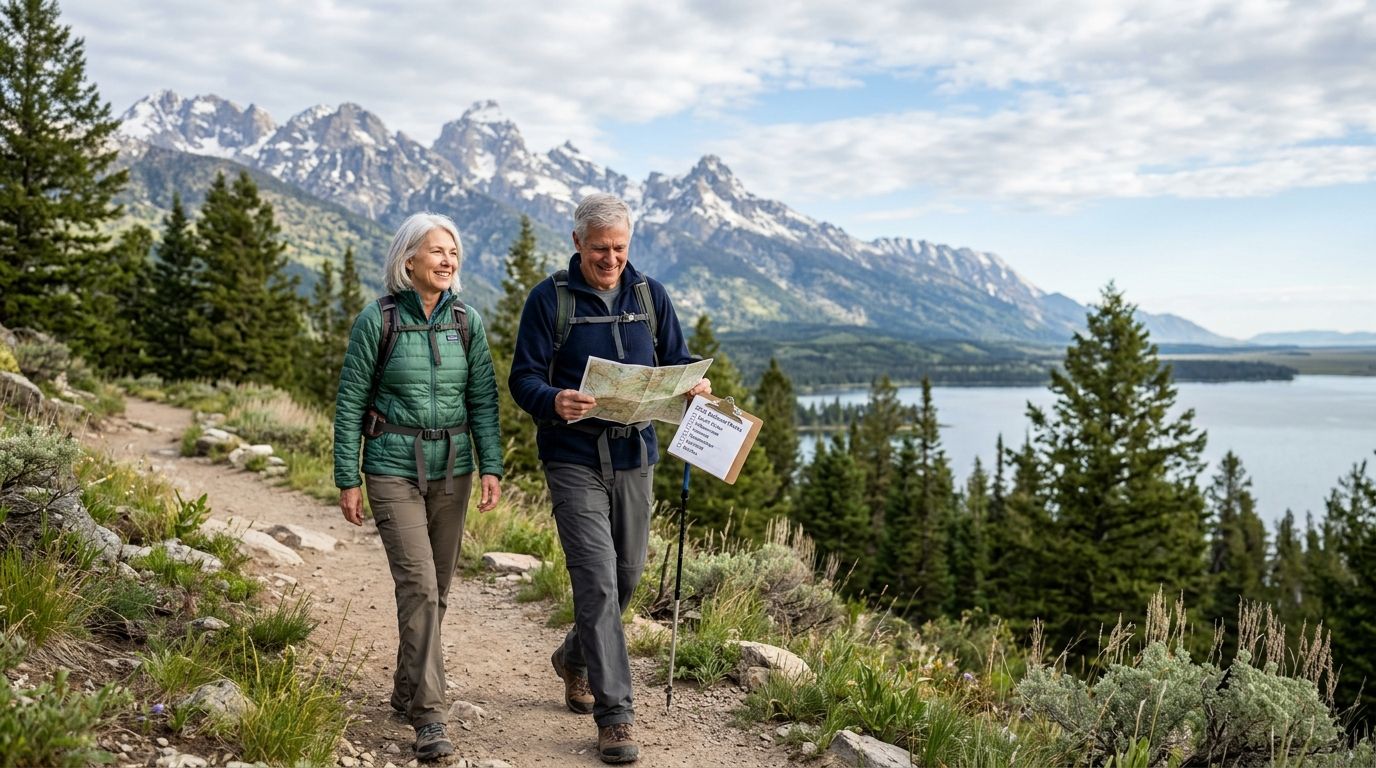
A national parks checklist for retirees works best when it's built around pace, not conquest: fewer parks per trip, shoulder-season timing, and a permanent record of what's already been checked off. This guide breaks down how to plan visits to all 63 national parks around a retiree's schedule, budget, and mobility needs, then shows where to track the progress once the trip is over.
- A national parks checklist for retirees works best split into regional loops, not a race through all 63 parks in one summer.
- The Senior Pass costs $80 for a lifetime and covers day-use fees for anyone 62 or older at every national park.
- Shoulder-season travel in April-May or September-October cuts crowds and heat for retirees moving at a slower pace.
- A printable checklist or wall poster gives retirees a permanent record that a phone app or memory can't match.
Why a national parks checklist matters for retirees
Retirees plan trips differently than working travelers, and a checklist has to account for that. Weekday travel is on the table, which means shoulder-season windows that a nine-to-five schedule can't touch. That flexibility is the single biggest advantage a retiree has over anyone still tied to a summer vacation calendar.
A fixed income also changes the math. The America the Beautiful Senior Pass costs $80 for a lifetime pass, or $20 for an annual one, and it covers entrance and day-use fees at every national park for anyone 62 or older. That one purchase pays for itself in two or three park visits at parks that charge a per-vehicle entrance fee.
Mobility and pacing matter more too. A checklist built for retirees needs fewer parks per trip, more rest days between drives, and honest notes about which trails and viewpoints are wheelchair- or cane-friendly. A national parks checklist for retirees isn't a shorter version of a younger traveler's list — it's a differently paced one.
Build the checklist step by step
Claim your Senior Pass before you book anything
The pass is the first move because it changes trip math from the start. Buy it in person at a park entrance, a USGS office, or online through the National Park Service, and bring proof of age.
- Confirm eligibility: U.S. citizens or permanent residents age 62 or older
- Buy the $80 lifetime version if more than four park visits are planned over the years
- Choose the $20 annual pass for a single big trip year
- Keep the physical pass in the glovebox, not packed in luggage
- Know it covers a carload at per-vehicle parks, not just the passholder
Cluster the 63 parks into regional loops
Chasing all 63 parks nationwide in one or two trips burns out even enthusiastic retirees. Group parks by region and knock out three to five per loop instead.
- Desert Southwest loop: Grand Canyon, Zion, Bryce Canyon, Capitol Reef
- California loop: Yosemite, Sequoia, Kings Canyon, Joshua Tree
- Rocky Mountain loop: Rocky Mountain, Grand Teton, Yellowstone
- Appalachian loop: Great Smoky Mountains, Shenandoah, New River Gorge
- Pacific Northwest loop: Olympic, Mount Rainier, North Cascades
Time each loop to the shoulder season
Retirees who travel in April-May or September-October see 20-40% fewer visitors at marquee parks than peak-July crowds, based on aggregated visitor pattern reporting from the National Park Service. Shoulder season also means milder temperatures at desert parks like Death Valley or Big Bend.
- Avoid the week around July 4th and Labor Day at any top-10 park
- Target weekday arrivals, not Friday-Sunday, for lodging and parking
- Check each park's specific shoulder window — high-elevation parks like Rocky Mountain still have snow into May
- Book campgrounds and lodges 6+ months out even in shoulder season at Zion, Glacier, and Yosemite
- Ask a park's visitor center about ranger-led programs, which run lighter schedules outside summer
Check accessibility features before you go
Not every park trail or viewpoint works for every retiree, and the checklist should note that honestly rather than assume.
- Look up each park's official accessibility page for paved trail lengths and grades
- Note which visitor centers have accessible restrooms and parking
- Check whether a park offers accessible shuttle service (Zion and Yosemite both do)
- Ask about mobility device loaner programs at larger parks
- Flag parks with limited accessible lodging so alternate nearby options can be booked
Track every visit somewhere permanent
A mental tally of "we've done about 20 parks" falls apart fast once a family has been on the road for a decade. A written or printed record settles the argument and gives something to show grandkids.
A spreadsheet works if someone in the household maintains it. A phone app works until the phone gets a new owner or a factory reset. A printed national park checklist tracker solves both problems: it lives on the fridge or in the glovebox, gets checked off in pen at the visitor center, and doesn't depend on battery life. Retirees who want the record visible year-round often frame a national park checklist poster for wall display instead of tucking a sheet in a drawer.
Loop in family for a grandkids trip
A national parks checklist doubles as a multi-generation project. Kids and grandkids love checking boxes as much as retirees do, and it turns a single trip into a running family tradition.
- Bring a spare printed checklist for grandkids to fill in themselves
- Let kids pick one park per trip from the unfinished list
- Use the checklist as a gift — a filled-in tracker makes a good retirement or anniversary present
- Photograph the entrance sign at each park as visual proof to pair with the checklist
- Set a loose multi-year goal (10 parks by a milestone birthday) rather than a hard deadline
Bring the right pace gear, not peak gear
Retirees don't need summit gear for most national park visits — they need gear that supports a slower, longer day.
- Trekking poles for uneven terrain, even on easy trails
- A lightweight folding stool for overlooks and long ranger talks
- Layered clothing for parks with 30-degree temperature swings between morning and afternoon
- A printed map as backup — cell service drops out in most park interiors
- Extra water and electrolyte packets; altitude and dry air hit harder at 62 than at 32
Start checking off national parks
Browse the full lineup of Triptyka bucket-list checklists for travel and hobby collectors.
Comparing tracking options for retirees
| Option | Best for | Key limitation |
|---|---|---|
| Spreadsheet | Retirees comfortable with tech who already track other hobbies digitally | Easy to abandon once travel picks up; no visual payoff |
| National Park Service app | Real-time maps, alerts, and trail conditions | Not built to log personal visit history over years |
| Notebook or journal | Retirees who like handwritten notes and trip journaling | Not shareable with family, easy to misplace on the road |
| Printable checklist | Retirees who want a portable, framable way to track all 63 parks | Requires printing at home or a print shop before a trip |
| Wall poster checklist | Retirees who want visible year-round progress at home | Static and needs manual updates in pen |
Verdict: a printable checklist wins for retirees who want a permanent, low-effort record that doesn't depend on a phone or a subscription.
Common mistakes retirees make with a national parks checklist
- Chasing all 63 parks in one or two summers. This turns a hobby into a chore and skips the slower pace that makes the trips enjoyable.
- Booking peak July and August dates out of habit. Retirees have the freedom to travel in April or October and routinely skip the worst crowds and heat by doing it.
- Assuming every trail is accessible without checking first. Park accessibility varies widely, and finding out at the trailhead wastes a travel day.
- Forgetting to buy the Senior Pass before the first stop. Some retirees pay full entrance fees for a year or two before learning the $80 lifetime pass exists.
- Keeping the visited-parks list only in memory. Without a written record, it's common to lose track of exactly which parks and which years, especially past park number 15 or 20.
Retirees planning a full cross-country loop often overlap with RV travel logistics — the national parks checklist for RV travelers covers campground booking windows and rig-size restrictions that matter for longer trips.
For retirees who also like quieter stargazing stops between the big-name parks, a dark sky park checklist tracker pairs well with the national park loop since several national parks double as certified dark sky sites.
FAQ
What's the best national parks checklist for retirees in 2026?
A printable checklist that tracks all 63 national parks and can be checked off by hand works best for retirees, since it doesn't depend on a phone account or app subscription. Pair it with regional trip loops and shoulder-season timing for the easiest pace.
How much does the America the Beautiful Senior Pass cost?
The Senior Pass costs $80 for a lifetime pass or $20 for an annual pass as of 2026. It covers entrance and day-use fees at all 63 national parks for anyone 62 or older, plus the accompanying vehicle.
How many national parks are there in 2026?
There are 63 sites carrying the official 'National Park' designation in the U.S. system in 2026. The broader National Park Service also manages hundreds of other units like monuments, seashores, and historic sites that don't carry the National Park title.
What's the best time of year for retirees to visit national parks?
Shoulder seasons in April-May and September-October are best for retirees, with smaller crowds and milder temperatures at most parks. High-elevation parks like Rocky Mountain or Glacier still have snow into late May, so check specific opening dates first.
Are national parks accessible for retirees with mobility limitations?
Accessibility varies significantly by park, but most major parks including Zion and Yosemite offer paved accessible trails, accessible shuttles, and ADA-compliant visitor centers. Check each park's official accessibility page before booking lodging or planning a route.
How do retirees track which national parks they've visited?
A printed checklist or wall poster is the most reliable method since it doesn't rely on phone storage or app accounts that can get lost between device upgrades. Spreadsheets and apps work too, but only if one household member keeps them updated consistently.
Can retirees combine national parks with RV travel?
Yes, RV travel is common among retirees doing multi-park loops since it removes nightly lodging bookings from the itinerary. Campground reservations at popular parks like Yellowstone and Zion still need to be made 6 or more months in advance.
Is a printable checklist better than an app for tracking visits?
For retirees specifically, a printable checklist tends to hold up better long-term since it doesn't require an account, a charged phone, or app updates. It also doubles as a keepsake or gift once it's filled in.
One last thing
The Senior Pass covers more than the 63 national parks — it's an interagency pass, so it also applies at national forests, wildlife refuges, and other federal recreation sites managed outside the National Park Service. A retiree checking off national parks with the pass in the glovebox is usually covered at several extra stops along the drive between parks, without buying a second pass.