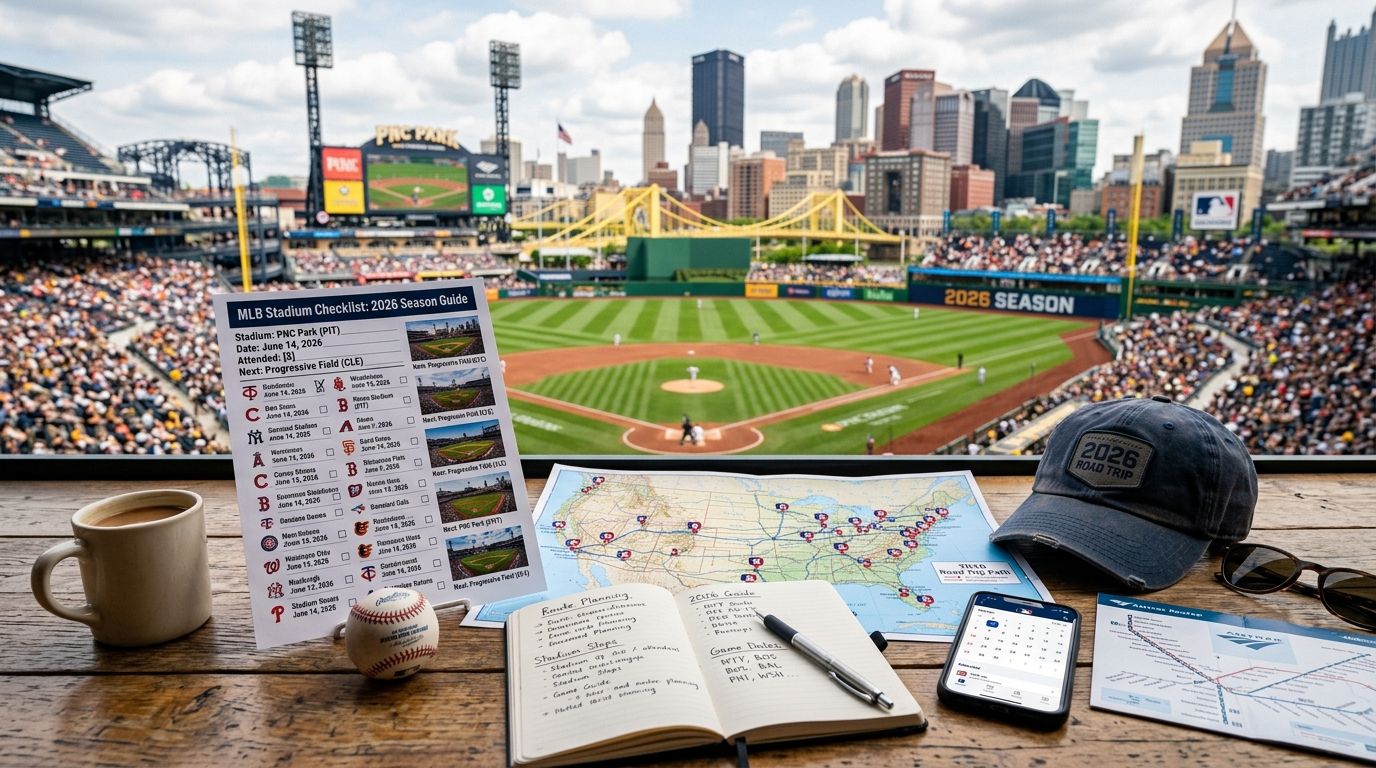
Road trip planners need an MLB stadium checklist that groups all 30 ballparks by drivable cluster, not by division standings, so the trip actually gets finished. A collector who flies to games can hit any city in any order. A road trip planner is stuck with interstates, home stands, and a gas budget, which means the checklist has to double as a route map, not just a list of names to check off.
- An MLB stadium checklist for road trip planners groups all 30 ballparks by geographic cluster, not alphabetically or by division.
- Triptyka's printable ballpark checklist is built for logging visit dates and notes offline, which matters more on the road than in an app.
- MLB's regular season runs roughly six months, late March through early October in 2026, so cluster trips need to line up with home stands.
- Northeast, Midwest, Texas, and West Coast clusters each hold 3-6 stadiums drivable in a single week-long leg.
- Skip alphabetical planning: it turns a 30-stadium bucket list into three times the driving distance.
Why an MLB stadium checklist matters for road trip planners
A road trip planner searching for an MLB stadium checklist isn't looking for stadium trivia. They're looking for a way to sequence 30 ballparks into legs that fit a vacation calendar and a tank of gas. The stadiums aren't spread evenly: the Northeast holds a tight cluster (Yankee Stadium, Citi Field, Fenway Park, Citizens Bank Park, Camden Yards, Nationals Park), the Midwest holds another (Wrigley Field, Comerica Park, Progressive Field, Great American Ball Park, PNC Park), and Texas and the West Coast each form their own drivable loops.
That clustering is the whole point of planning by road trip instead of by flight. A checklist that lists 30 team names alphabetically forces a planner to do the geography math themselves, every single time they add a stop. A checklist built around clusters does that math once, up front, in 2026, and lets the planner reuse it for every trip after.
How to build an MLB stadium road trip checklist that actually gets finished
Map your ballpark clusters before you book anything
Start with geography, not with a bucket list ranked by best-ballpark articles. Group stadiums into drivable regions first.
- Northeast cluster: Yankee Stadium, Citi Field, Fenway Park, Citizens Bank Park, Camden Yards, Nationals Park
- Midwest cluster: Wrigley Field, Comerica Park, Progressive Field, Great American Ball Park, PNC Park
- Texas and South cluster: Globe Life Field, Daikin Park, Truist Park
- West Coast cluster: Dodger Stadium, Petco Park, Oracle Park, T-Mobile Park
Check home schedules before you set travel dates
A cluster only works if the teams are actually home when the road trip passes through. Cross-reference each team's home stand calendar before locking a date.
- Pull each team's home schedule for the month you're targeting in 2026
- Flag the All-Star break week, since every team is off
- Note weekday versus weekend games for parking and crowd differences
- Build in one flex day per cluster for a rainout or rescheduled game
Choose a route order that saves miles, not just time
Once the cluster and dates are set, the order inside the cluster still matters. A Northeast loop run north-to-south covers less backtracking than one bouncing between cities out of order.
- Map drive times between every stadium pair in the cluster, not just neighbors
- Put the longest single drive at the start or end of the trip, not the middle
- Build overnight stops around stadium cities, not halfway points
Track what you've actually seen at each stop
This is where most road trip planners lose momentum: three stadiums into a five-stop trip, memory of what happened where gets fuzzy. A phone note works until the battery dies or the app gets deleted. A printable checklist survives both. Triptyka's MLB ballpark checklist is built for exactly this kind of tracking, with room to log the date, the seat, and the one detail worth remembering at each park.
- Log the visit date and opponent at each stop
- Note the best seat section or view, not just "good seats"
- Record one don't-miss food item per ballpark
- Mark off the stadium the day of the visit, not after the trip ends
Budget for tickets, parking, and food separately
Stadium road trips run over budget on parking and concessions more often than on tickets. Separate the three categories when planning a multi-stop leg.
- Price parking near the stadium, not just the cheapest lot in town
- Set a per-game food budget so one ballpark's specialty item doesn't eat the whole day's spend
- Compare walk-up pricing against advance pricing for lower-demand weekday games
Build in buffer days for weather and rainouts
A five-stadium week with zero slack falls apart the first time a game gets postponed. Buffer days protect the whole itinerary.
- Add one buffer day per three stadiums in a cluster
- Check each ballpark's roof status (retractable, open-air, dome) before counting on weather
- Keep a backup activity near each stadium city for a buffer day that isn't needed
Get the printable ballpark checklist
Track all 30 MLB stadiums by cluster with room for dates, seats, and notes.
Comparison: ways to track an MLB stadium road trip
| Option | Best for | Key limitation |
|---|---|---|
| Printable checklist (MLB stadium checklists and trackers) | Planners who want an offline record with dates and notes | No live schedule sync; needs manual updates when a stadium changes |
| DIY spreadsheet | Planners who want fully custom columns | No cluster map built in, so every trip means redoing the geography |
| General checklist apps | Planners who want everything on their phone | Requires the app open and a charged phone at the gate |
| Official MLB Ballpark app | Buying tickets and mobile entry | Not built for tracking bucket-list progress across seasons |
Verdict: for road trip planners specifically, a printable checklist wins because it works with zero signal and zero battery, which matters more between rural stadium cities in 2026 than any digital feature.
Common mistakes road trip planners make with MLB stadium checklists
- Planning by division instead of by geography. AL and NL divisions don't map to drivable clusters; a checklist sorted by standings instead of location adds hundreds of extra miles.
- Booking travel before checking home stands. Arriving to find the home team on a road trip is the single most avoidable mistake in ballpark road trip planning.
- Skipping the buffer day. One rainout with no slack in the schedule can cost an entire stadium off the list.
- Tracking progress only in memory. Without a written checklist, planners repeat a stadium they already visited or forget which seat or food item they meant to try next time.
- Ignoring parking logistics until game day. Ballpark parking fills fast on weekend games, and sorting it out the morning of costs an inning or more.
FAQ
What's the best MLB stadium checklist for road trip planners in 2026?
A printable checklist organized by geographic cluster, like Triptyka's 30-ballpark tracker, works best for road trip planners because it maps drivable regions instead of listing teams alphabetically. It also survives dead phone batteries and no-signal stretches between stadium cities.
How many MLB stadiums are there to visit?
There are 30 MLB stadiums total, split between the American League and National League. A full road trip checklist needs all 30 tracked to call the collection complete.
Is a printable checklist better than an app for tracking ballparks?
For road trips specifically, yes: a printable checklist doesn't depend on cell signal, an app being installed, or a charged phone at the gate. Apps work better for buying tickets and mobile entry, not for logging a multi-year bucket list.
How long does it take to visit all 30 MLB stadiums?
Most road trip planners spread the 30 stadiums across several seasons rather than one trip, since the regular season runs roughly six months and travel between coastal clusters alone takes days. A single well-planned road trip realistically covers one regional cluster of three to six stadiums.
What's the best route order for an MLB ballpark road trip?
Group stadiums by region first (Northeast, Midwest, Texas, West Coast), then order stops within that cluster to minimize backtracking. Put the longest single drive at either end of the trip rather than the middle.
Is Triptyka better than a checklist app for tracking MLB stadiums?
Triptyka's checklist is a printable, purpose-built ballpark tracker with room for visit dates, seats, and notes, while general checklist apps aren't built specifically for stadium bucket lists. Which one wins depends on whether the planner wants a physical passport or a phone-based tool.
What's the best time of year for an MLB stadium road trip?
Late spring through mid-summer in 2026 gives the widest window before the All-Star break, avoiding both the thin early-season schedule and the crowded September stretch. Weekday games also cut down on parking and crowd pressure at every stop.
One last thing
The stadiums road trip planners skip most often aren't the far-flung ones. They're the parks inside a cluster the planner already drove through. Someone doing the Midwest loop for Wrigley Field and Comerica Park regularly misses Great American Ball Park or PNC Park sitting one state over, because the checklist wasn't sorted by cluster in the first place. Sort by geography first, and most of those misses disappear.