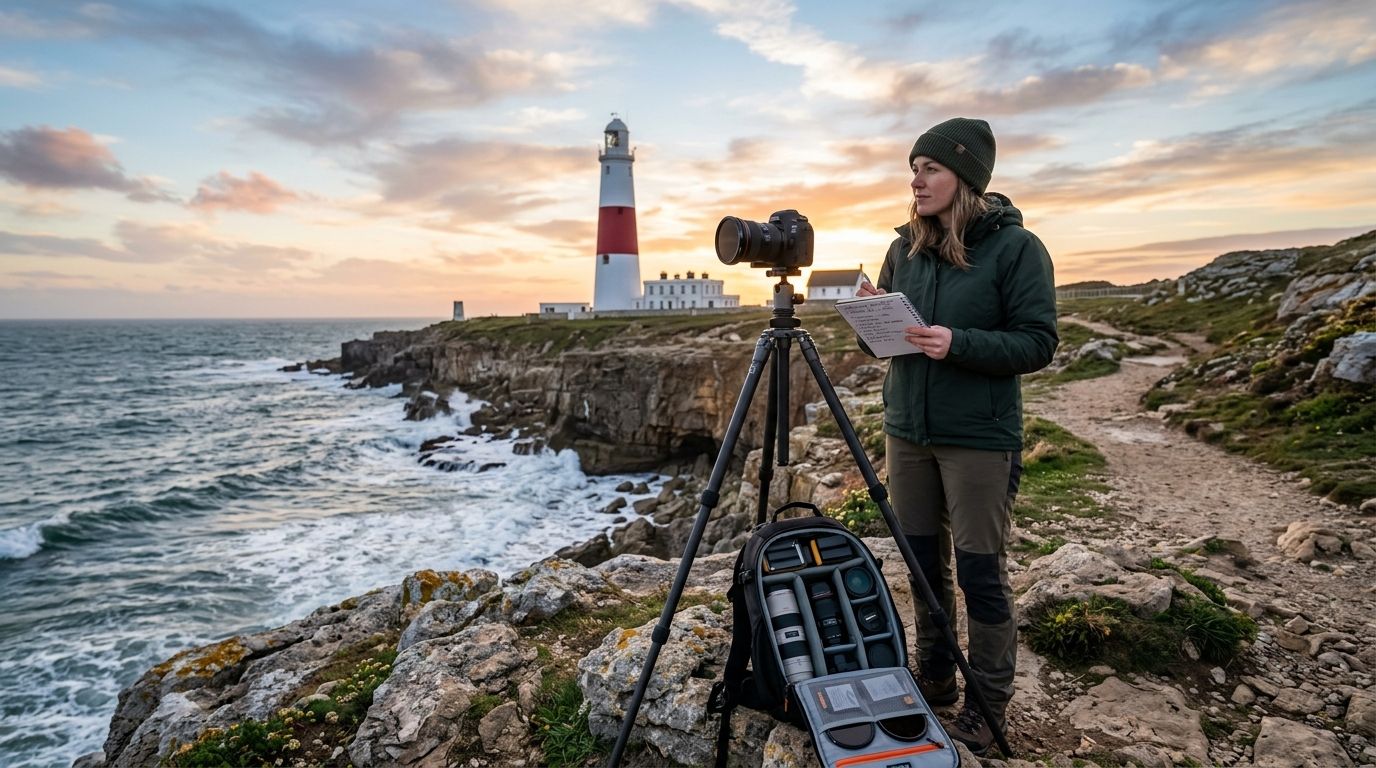
A lighthouse checklist for photographers is a tracking list of lighthouses ranked by shoot-specific factors — light direction, tower access, and seasonal closures — instead of just straight-line distance. Casual travelers check off a lighthouse once they've seen it; photographers need to know when the light hits the lens and whether the catwalk is even open.
- A lighthouse checklist for photographers should rank sites by golden-hour access and tower-climb rules, not mileage.
- Free spreadsheets work but lose photographers offline at remote coastal sites with no signal.
- Triptyka's printable lighthouse checklist tracker adds shoot-specific fields: light direction, parking distance, seasonal closures.
- Roughly 700 historic light stations still stand in the US, so a ranked shortlist beats an unranked master list.
Why lighthouse checklists matter for photographers
A generic bucket-list app treats every lighthouse the same: name, location, checked or not. That's fine for a road-trip souvenir hunt. It falls apart the moment your shoot depends on the sun rising over the water instead of behind the tower, or on the light station's catwalk being open to the public that week.
Photographers plan around constraints a casual visitor never thinks about: tide tables, fog season, nesting-bird closures, and whether the lighthouse checklist tracker you're using even has a field for compass direction. A checklist built for this segment needs to hold shoot notes, not just a checkmark.
That's the gap between a travel checklist and a photography checklist. One tells you where you've been. The other tells you when to show up and where to stand.
Build your lighthouse photography checklist step by step
Map every lighthouse within your shoot radius
Start with a raw list before you rank anything. Pull from public sources so you're not missing towers that don't show up on a quick search.
- US Lighthouse Society state-by-state directories
- National Park Service historic light station records
- NOAA nautical charts, which mark active aids to navigation
- State tourism board lighthouse trails (common in Maine, Michigan, and North Carolina)
- Local historical society pages for decommissioned or relocated towers
Rank each lighthouse by light direction and time of day
A lighthouse facing east photographs best at sunrise; one facing open water to the west rewards sunset shooters. Note this before you drive, not after you've burned a tank of gas on the wrong coast.
- Compass orientation of the tower relative to the water
- Whether the light beam itself is visible after dusk (some towers are decorative only)
- Foreground options: rocks, dunes, boardwalks, or a keeper's house
- Fog frequency for the region and month
- Sun position relative to the tower at your planned arrival time
Check access rules and climbing restrictions before you drive
Some towers are climbable seasonally, some never, and a few charge for interior access. Confirm this ahead of time — nothing wastes a 2026 shoot day like arriving to a locked gate.
- Public catwalk or gallery access days and hours
- Seasonal closures for nesting birds, common on East Coast towers spring through midsummer
- Private-property lighthouses that require advance permission
- Coast Guard-restricted active stations with no public access at all
- Parking distance, and whether it's a hike-in or a drive-up shot
Build a shot list per lighthouse
Once you know which towers are worth the drive, a spreadsheet starts to strain under the weight of shoot notes, weather windows, and gear reminders. This is where a printable field checklist earns its keep over a generic app: it's built for note-taking in the field, not just checkboxes.
Triptyka's lighthouse checklist tracker gives photographers a printable page with space to log light direction, best vantage point, and access notes next to each tower — so the plan lives on paper in your camera bag instead of buried in an app you can't open with cold hands.
- Preferred lens and focal length per tower
- Foreground element to include (dune grass, dock, rocks)
- Backup composition if the primary angle is blocked
- Notes from a prior visit, if you've shot the tower before
Track weather and tide windows
Coastal light changes fast. A checklist without weather context is a list of addresses, not a shoot plan.
- Local tide chart for the shoot date, especially for towers on sandbars or causeways
- NOAA marine forecast for fog and wind
- Moon phase, if you're planning a night shot with the beam lit
- Seasonal daylight hours for your target sunrise or sunset window
Plan the night and off-season calendar
Some of the sharpest lighthouse images come from dark-sky conditions, not daylight. Pair your lighthouse list with a dark sky park checklist if any towers on your 2026 route sit near certified dark-sky zones.
- Certified dark-sky sites near your lighthouse route
- New moon dates for star-trail or night-sky frames
- Off-season months when tourist crowds thin out
- Winter storm season for dramatic wave shots, with appropriate caution near exposed points
Log completed shoots and gear notes
After the shoot, the checklist becomes a reference for next time. Note what worked so you're not re-learning the same tower in 2027.
- Exposure settings that worked for the tower's light conditions
- Crowd levels by day of week and season
- Access issues encountered: locked gate, closed trail, no parking
- Whether the shot matched the plan or needed the backup composition
Lighthouse tracking options for photographers
| Option | Best for | Format | Key limitation |
|---|---|---|---|
| Free spreadsheet (Google Sheets) | DIY photographers who want full customization | Digital, cloud-synced | No offline access at remote coastal sites with weak signal |
| Generic lighthouse-finder app | Casual list-checking, not shoot planning | Mobile app | No fields for light direction or composition; drains battery pre-dawn |
| Triptyka lighthouse checklist tracker | Photographers who want a printable field guide with shoot notes | Printable PDF | No live tide or weather feed built in |
| Notion or Airtable database | Photographers combining trip planning with gear inventory | Digital, cross-platform | Setup takes hours before the first shoot |
Triptyka's printable lighthouse checklist wins for photographers who shoot before sunrise, when a phone app drains battery in the cold and cell service disappears on remote points.
Get a printable lighthouse checklist
Track light direction, access rules, and shot notes for every tower on your route.
Common mistakes photographers make with lighthouse checklists
- Chasing famous towers over well-lit ones. A well-known lighthouse under harsh midday light produces a worse frame than an obscure tower with a clean east-facing exposure.
- Skipping the tide chart. Several causeway and sandbar lighthouses become unreachable at high tide — check before you plan the drive, not when you're standing at the water's edge.
- Ignoring seasonal bird closures. Nesting season shuts down catwalk access on many East Coast towers from spring through midsummer.
- Relying only on a phone app with no offline mode. Coastal points are notorious dead zones; a printable checklist works with no signal and no battery drain.
- Listing one composition per tower. A blocked angle or maintenance scaffolding ends the shoot if the checklist has no backup plan.
FAQ
What's the best lighthouse checklist for photographers in 2026?
A checklist that ranks towers by light direction, access rules, and season beats a plain visited/not-visited list. Triptyka's printable lighthouse checklist tracker adds fields for shoot notes and vantage points alongside standard location data.
Is a printable checklist better than a lighthouse app for photography trips?
For pre-dawn or remote coastal shoots, yes — printable checklists don't drain phone battery in the cold and work with zero cell signal. Apps are fine for casual sightseeing but rarely have fields for light angle or composition.
How do I find the best light angle at a lighthouse before I arrive?
Check the tower's compass orientation against your planned arrival time using a sun-position app or map, then confirm whether the beam itself is visible after dusk. Many decorative lighthouses no longer operate a light at night.
Which lighthouses allow tower climbs for photos?
Access varies by site and season — some allow public catwalk climbs on set days, and Coast Guard-restricted stations allow none at all. Confirm hours directly with the organization managing the site before you drive out.
What's the best time of year to photograph lighthouses on the East Coast?
Late spring and early fall generally bring clearer skies and thinner crowds, though nesting-bird closures often run from spring through midsummer on many towers. Winter storm season produces dramatic wave shots but demands extra caution near exposed points.
Should I track decommissioned lighthouses in my checklist?
Yes, if photography is the goal — decommissioned towers often have easier access and fewer restrictions than active Coast Guard stations. They just won't have a working beam to photograph at night.
Do I need cell service to use a lighthouse checklist while shooting?
No, if the checklist is printable. Coastal points are common dead zones, which is the main argument for paper over an app-based tracker.
How many lighthouses are there to photograph in the US?
Public records from the US Lighthouse Society put surviving historic light stations at roughly 700 nationwide. Not all are photogenic or accessible, which is exactly why a ranked shortlist matters more than a full inventory.
One last thing
The lighthouses with the best light are rarely the most photographed ones. Famous towers come with crowded parking lots and tour buses, while a lesser-known station two counties over often has an empty overlook and cleaner sightlines. Rank your 2026 shoot list by light and access first, fame second, and you'll come home with better frames than the postcard crowd.