Hiking to every major waterfall in one national park takes anywhere from a focused two-to-three-day weekend to a multi-season project, and the difference comes down to how many named falls that specific park holds and how far apart its trailheads sit.
- Yosemite's three signature falls (Yosemite Falls, Vernal Fall, Nevada Fall) add up to about 15.6 miles round trip, doable in 2 to 3 days in 2026.
- Great Smoky Mountains National Park holds more than 40 named waterfalls across separate trailheads, so hitting every major one becomes a multi-trip project, not a single visit.
- Snowmelt season, roughly April through June, is when Sierra and Appalachian waterfalls run fullest; several dry to a trickle by late summer.
- A printable waterfall checklist tracker keeps score across multiple trips instead of trying to remember a single park visit.
Why this matters
The question "how long to hike every waterfall in a national park" doesn't have one universal answer because national parks aren't built the same way. Some, like Yosemite, pack their marquee falls into a single valley you can walk between on foot. Others, like Great Smoky Mountains National Park, scatter dozens of named falls across trailheads that are an hour's drive apart.
That structural difference is the whole ballgame for planning a 2026 trip. Anyone trying to check off "every major waterfall" in a park needs to know upfront whether they're looking at a long weekend or a checklist that spans several visits. A waterfall checklist tracker makes that distinction concrete by listing the named falls per park so you can see the scope before you book anything.
How long does it take to hike to every major waterfall in a national park?
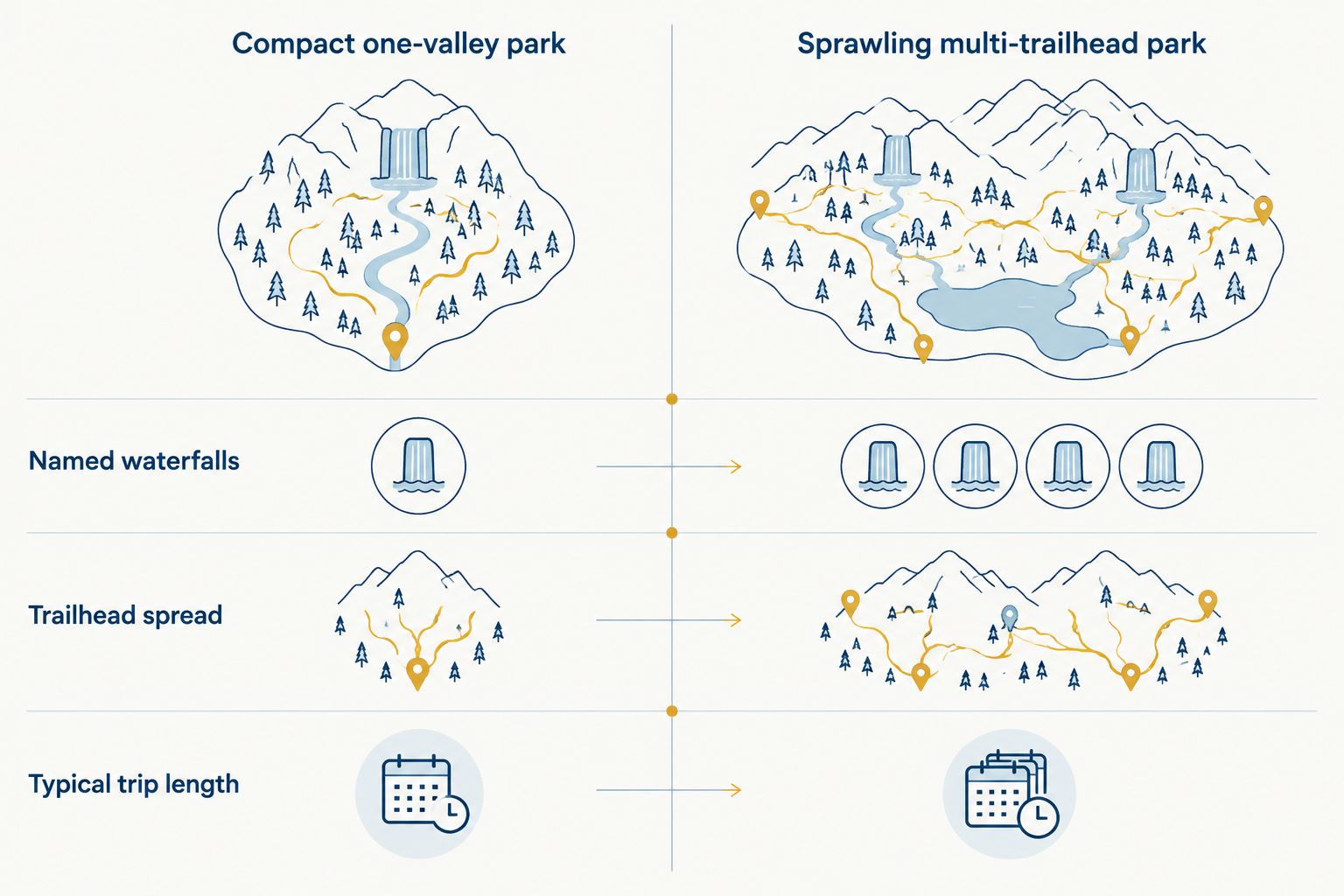
In a compact, single-valley park, expect 2 to 3 days of hiking to cover the marquee named waterfalls. In a sprawling park with dozens of scattered falls, treat it as a multi-trip project across a season or more, not something you finish on one visit.
| Park | Named major waterfalls | Trail approach | Typical time to hit them all |
|---|---|---|---|
| Yosemite National Park | 3-4 marquee falls concentrated in the valley | Paved and granite-step trails from the valley floor | 2-3 days |
| Great Smoky Mountains National Park | 40+ named falls | Dozens of separate trailheads across two states | Multiple trips across a season or more |
| Zion National Park | A handful of named falls, including seasonal Emerald Pools and Weeping Rock | Shuttle-only access during peak months | 1-2 days, shuttle schedule dependent |
| Glacier National Park | Several named falls along the Going-to-the-Sun Road corridor | Seasonal road and trail closures for snow | 2-4 days, weather dependent |
The pattern holds across every park: fewer named falls concentrated near one trailhead means a short trip, and more falls spread across a bigger footprint means a longer one.
Yosemite's big three waterfalls: 15.6 miles round trip in 2 to 3 days
Yosemite's three most-hiked named falls sit inside walking distance of each other in Yosemite Valley. The Upper Yosemite Fall Trail runs 7.2 miles round trip on its own. The Mist Trail to Vernal Fall is 3 miles round trip, and continuing past Vernal to Nevada Fall brings that same trail to 5.4 miles round trip. Add them up and you're covering roughly 15.6 miles of trail to bag all three.
At a standard hiking pace of about 2 miles per hour on steep, well-maintained trail, budget 4 to 5 hours for the Yosemite Falls climb alone and another half-day for the Mist Trail combination. Split across two or three days with rest and travel time between hikes, that's a realistic weekend project in 2026, no backcountry permit required for any of the three.
Best for: hikers who want a short, structured national park waterfall trip without applying for a wilderness permit. Skip if you're visiting in late summer, when Yosemite Falls itself often reduces to a trickle.
Great Smoky Mountains: 40+ named waterfalls, no single trip covers them
Great Smoky Mountains National Park is commonly cited as the national park with the most named waterfalls, with more than 40 spread across the Tennessee and North Carolina sides of the park. Unlike Yosemite's valley layout, these falls don't connect into a walkable loop. Reaching them means driving to a different trailhead for nearly every hike.
That spread is exactly why "every major waterfall" in the Smokies isn't a weekend goal. It's a running project that most people tackle over multiple seasons, picking off a handful of falls per trip based on which side of the park they're visiting.
Best for: collectors who treat national park waterfalls as an ongoing hobby rather than a single checklist to close out. Skip if you want to finish in one visit — the Smokies aren't built for that.
Why the timeline varies
- Number of named waterfalls — a park with 3-4 falls closes out fast; a park with 40+ never really "finishes" in one trip.
- Trail mileage and elevation gain per fall — Yosemite's Mist Trail gains elevation quickly on granite steps, which slows pace more than flat mileage suggests.
- Seasonal water flow — spring snowmelt fills western falls; several, including Yosemite Falls, thin out by late summer.
- Permit and shuttle requirements — Zion's shuttle windows and Half Dome's separate permit (beyond Nevada Fall) both add scheduling constraints.
- Trailhead spacing — a single valley versus dozens of pull-offs across a park is the biggest driver of total trip length.
- Road and trail closures — Glacier's Going-to-the-Sun Road typically doesn't fully open until late spring, which delays access to falls along that corridor.
A printable waterfall checklist for hiking clubs is built around this exact problem: it lists named falls by park so a group can plan which ones to hit on which trip instead of guessing at the scope. Triptyka's bucket-list checklists work the same way across other categories — you check off entries as you complete them rather than tracking progress from memory.
Track your waterfall bucket list
Printable checklists for national park waterfalls, trails, and more.
Related questions
Which national park has the most waterfalls?
Great Smoky Mountains National Park is widely cited as the national park with the most named waterfalls, with more than 40 scattered across its Tennessee and North Carolina sides in 2026. Yosemite has far fewer named falls but concentrates them inside one valley, which is why it feels more "finishable" as a trip.
What time of year is best for waterfall hikes in national parks?
Spring snowmelt, roughly April through June, is when most western waterfalls run at peak flow, and several — including Yosemite Falls — slow to a trickle or dry out by late summer. Appalachian waterfalls in the Smokies are rain-fed rather than snowmelt-fed, so they tend to run more consistently across the year.
How do you keep track of which waterfalls you've hiked?
A printable checklist that lists each named waterfall by park and trailhead lets you check them off trip by trip instead of relying on memory. Pairing it with an app to track waterfall hikes in AllTrails logs the route and mileage for each individual hike alongside your checklist.
FAQ
How long does it take to hike Yosemite's three main waterfalls?
Yosemite's three main named falls add up to about 15.6 miles round trip, which most hikers spread across 2 to 3 days in 2026. Doing all three in a single day is possible for very fit hikers but leaves little time to enjoy any of them.
How many named waterfalls does Great Smoky Mountains National Park have?
Great Smoky Mountains National Park is commonly cited as having more than 40 named waterfalls. They're spread across dozens of separate trailheads on both the Tennessee and North Carolina sides of the park.
Is it possible to hike to every waterfall in a national park in one trip?
In a compact park like Yosemite, yes — the marquee falls sit within a few miles of each other in one valley. In a sprawling park like the Smokies, no single trip covers all 40-plus named falls.
What's the best month to see national park waterfalls at peak flow?
May and June are typically peak flow months in most western parks, driven by spring snowmelt. By August, several snowmelt-fed falls, including Yosemite Falls, thin dramatically or dry up entirely.
Do you need a permit to hike to Yosemite Falls or Vernal Fall?
No day-use permit is required for the Yosemite Falls Trail or the Mist Trail to Vernal Fall in 2026. A separate permit is required only if you continue past Nevada Fall to Half Dome.
Which is longer, the hike to Vernal Fall or Nevada Fall?
The hike to Nevada Fall is longer at 5.4 miles round trip via the Mist Trail, compared to 3 miles round trip for Vernal Fall alone. Both start on the same trailhead, so many hikers do Vernal Fall first and decide whether to continue.
How do you keep track of which national park waterfalls you've hiked?
A printable waterfall checklist tracker lists named falls by park so you can check them off as you complete each hike. That's more reliable than trying to remember trailheads across multiple trips or seasons.
One last thing
The waterfall most people assume they'll see year-round — Yosemite Falls — is also the one most likely to disappoint a late-summer visit. It's fed almost entirely by snowmelt, so by August it can drop to a trickle or stop running altogether, while the Mist Trail falls fed by Merced River flow hold up better into the season. If checking off "every major waterfall" in Yosemite is the goal for 2026, plan the trip for May or June, not August.