A typical wine trail groups 15 to 30 vineyards or wineries under one shared map in 2026, though the count swings from a handful of stops on a boutique county route to well over 100 across a sprawling AVA network like Napa Valley or the Finger Lakes. That headline number usually counts only trail-association members with a tasting room open to visitors — it leaves out working vineyards that sell grapes but don't pour, and it leaves out wineries that dropped their trail membership but still welcome walk-ins. The same region can show a dozen stops on one map and 40 on another depending on which tourism board or wine association published the list.
- Most published wine trails list 15 to 30 vineyards or wineries as of 2026.
- Boutique county trails run 5 to 15 stops; major AVA networks like Napa Valley top 100.
- Trail counts shift as small vineyards join, go seasonal, or drop association membership.
- Anything over 40 stops is a multi-visit bucket-list project, not a weekend trip.
Why this matters
Planning a wine trail day around the wrong headcount either wastes a Saturday circling closed tasting rooms or leaves you stuck at a stop that wasn't even on your list. Trail associations update member rosters every season as small vineyards join, go seasonal-only, or close, so the number on a state tourism page in January isn't always what's true in June 2026.
For a collector tracking visits the way Triptyka frames it — treating each stop as a mark toward a bigger list — knowing the real vineyard count on a trail before you leave home is the difference between a finished checklist and a half-finished one.
How many vineyards are on a wine trail, exactly?
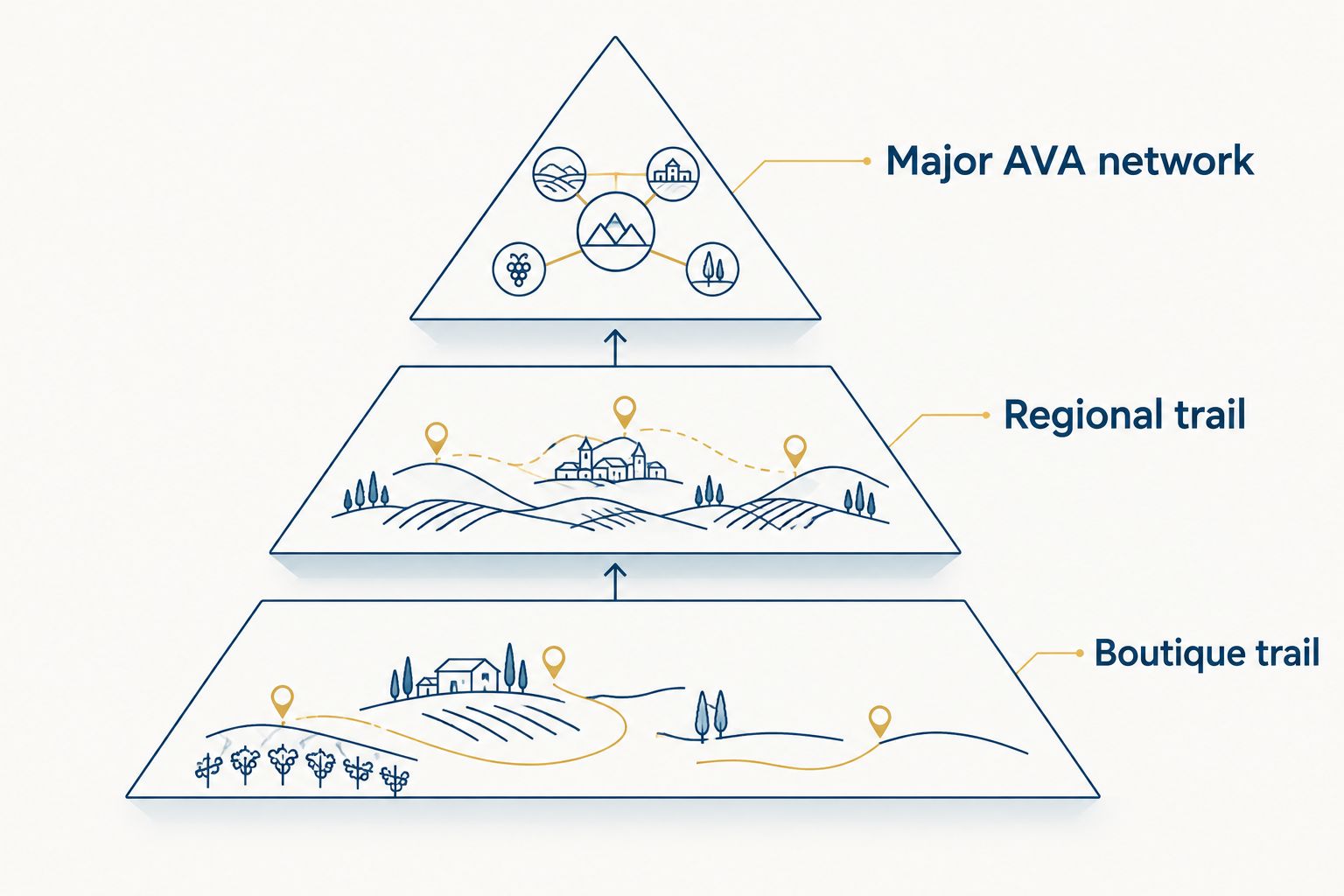
| Trail type | Typical vineyard/winery count | Best for |
|---|---|---|
| Boutique or single-county trail | 5 to 15 stops | A relaxed weekend with time to linger at each stop |
| Standard regional wine trail | 15 to 30 stops | Most published US wine trails; a 2-3 day visit |
| Major AVA network (Napa, Sonoma, Finger Lakes) | 40 to 100+ stops | Multi-trip bucket-list travel, not a single weekend |
Most wine trails you'll find on a state tourism site fall in the 15-to-30 range in 2026 — treat anything over 40 as a project spread across multiple trips, not a checklist you clear in a day.
Boutique wine trails: 5 to 15 vineyards
These are the trails built around a single county or a cluster of family-run vineyards close enough to visit by car in one afternoon. They're common in emerging wine regions — parts of Michigan, Virginia, and Texas Hill Country host trails this size. Verdict: Buy these as a first bucket-list stop if you want a full trail cleared in a single day trip.
Standard regional wine trails: 15 to 30 vineyards
This is the size most people picture when they hear "wine trail." The Finger Lakes region in New York splits its wineries across several named trails rather than one giant list — the Cayuga Lake Wine Trail runs closer to 15 members, while the Seneca Lake Wine Trail is one of the larger sub-trails at closer to 30. Verdict: Buy for a long weekend with two to three tasting stops planned per day.
Major AVA wine trail networks: 40 to 100+ vineyards
Napa Valley alone counts several hundred wineries region-wide, but most published "trail" maps break that into smaller sub-routes of 20 to 40 stops so a visitor isn't staring at an unworkable list. Sonoma follows the same pattern. Treating the whole AVA as one trail is technically accurate and practically useless for trip planning. Verdict: Wait — pick a sub-trail or a themed route (reds only, family-owned only) rather than attempting the full network in one visit.
Why the vineyard count varies
- Definition of "trail" — a county tourism board's list and a private wine club's list of the same region rarely match.
- Tasting-room requirement — many counts exclude working vineyards that grow grapes for other labels but don't pour for visitors.
- Seasonal membership — smaller family vineyards often join a trail association only for the busy season, then drop off winter rosters.
- Geographic sprawl — a compact county trail naturally has fewer stops than a multi-county or multi-state route.
- Association turnover — trails lose and gain members every year, and the same pattern shows up on the Kentucky Bourbon Trail, where the official stop count has changed more than once as distilleries joined or left.
- Sub-trail splitting — large AVAs break one region into several named routes instead of publishing a single master list.
“Treat anything over 40 stops as a multi-visit project, not a checklist you clear in one weekend.”
Travelers building out a bucket list around this hobby usually want a running total, not just a trip itinerary — that's the gap a vineyard and wine trail checklist tracker is built to close, since it tracks visits against the current published roster instead of a number that goes stale by 2027.
Track your wine trail progress
Check off vineyards as you visit instead of guessing which trail map is current.
How many wineries are on the Finger Lakes wine trail?
The Finger Lakes region splits its wineries across several named sub-trails rather than one combined list, with individual trails like Cayuga Lake and Seneca Lake each running roughly 15 to 30 member wineries. Combined across all Finger Lakes trails, the total winery count for the region is well over 100. Planning by sub-trail, not the full region, keeps a visit to a manageable single day or weekend.
Is Napa Valley one wine trail or several?
Napa Valley is not one official wine trail — it's a full AVA region with several hundred wineries, most of which never appear together on a single published trail map. Visitors typically follow a themed sub-route of 20 to 40 wineries instead of attempting the whole valley. Treating Napa as "one trail" is the fastest way to plan an unrealistic itinerary.
How long does it take to do an entire wine trail?
A standard 15-to-30-vineyard regional trail takes 2 to 3 days at a pace of two to three tastings per day, which is roughly what most tasting rooms can comfortably handle before palate fatigue sets in. A boutique 5-to-15-stop trail fits into a single day. A major AVA network with 40 or more stops realistically takes multiple separate trips spread across a season, not one continuous visit.
FAQ
How many vineyards are on a typical wine trail?
A typical wine trail lists 15 to 30 vineyards or wineries in 2026. Boutique county trails run smaller, around 5 to 15 stops, while major AVA networks like Napa or Sonoma exceed 100 wineries region-wide.
How many wineries are on the Finger Lakes wine trail?
Individual Finger Lakes sub-trails like Cayuga Lake and Seneca Lake each run roughly 15 to 30 member wineries. The whole Finger Lakes region combined exceeds 100 wineries across all its named trails.
Is Napa Valley considered one wine trail?
No, Napa Valley is an AVA with several hundred wineries, and most published trail maps break it into smaller themed sub-routes of 20 to 40 stops rather than one master list.
How long does it take to visit an entire wine trail?
A standard 15-to-30-vineyard trail takes 2 to 3 days at two to three tastings per day. A boutique 5-to-15-stop trail fits into a single day trip.
What's the difference between a wine trail and an AVA?
A wine trail is a curated, publicized route of member wineries, while an AVA (American Viticultural Area) is a legally defined growing region that can contain far more wineries than any single trail lists.
How many stops should I plan per day on a wine trail?
Two to three tasting stops per day is standard on most published wine trails in 2026, which lets a 15-to-30-vineyard trail fit into a long weekend.
Are all wine trail vineyards open to the public?
No, published trail counts typically exclude working vineyards that grow grapes for other labels but don't operate a public tasting room.
Why does the same wine trail show different vineyard counts online?
Trail rosters change seasonally as small vineyards join or drop membership, and different tourism boards or associations publish their own separate lists for the same region.
One last thing
The number that actually matters isn't the total on a tourism board's homepage — it's the count on the specific map you're driving that day, since two sources covering the same region can differ by a dozen wineries or more. Pull the current roster the morning of your trip, not the one you bookmarked in 2025, and treat any trail over 40 stops as a season-long project instead of a single checklist item.