
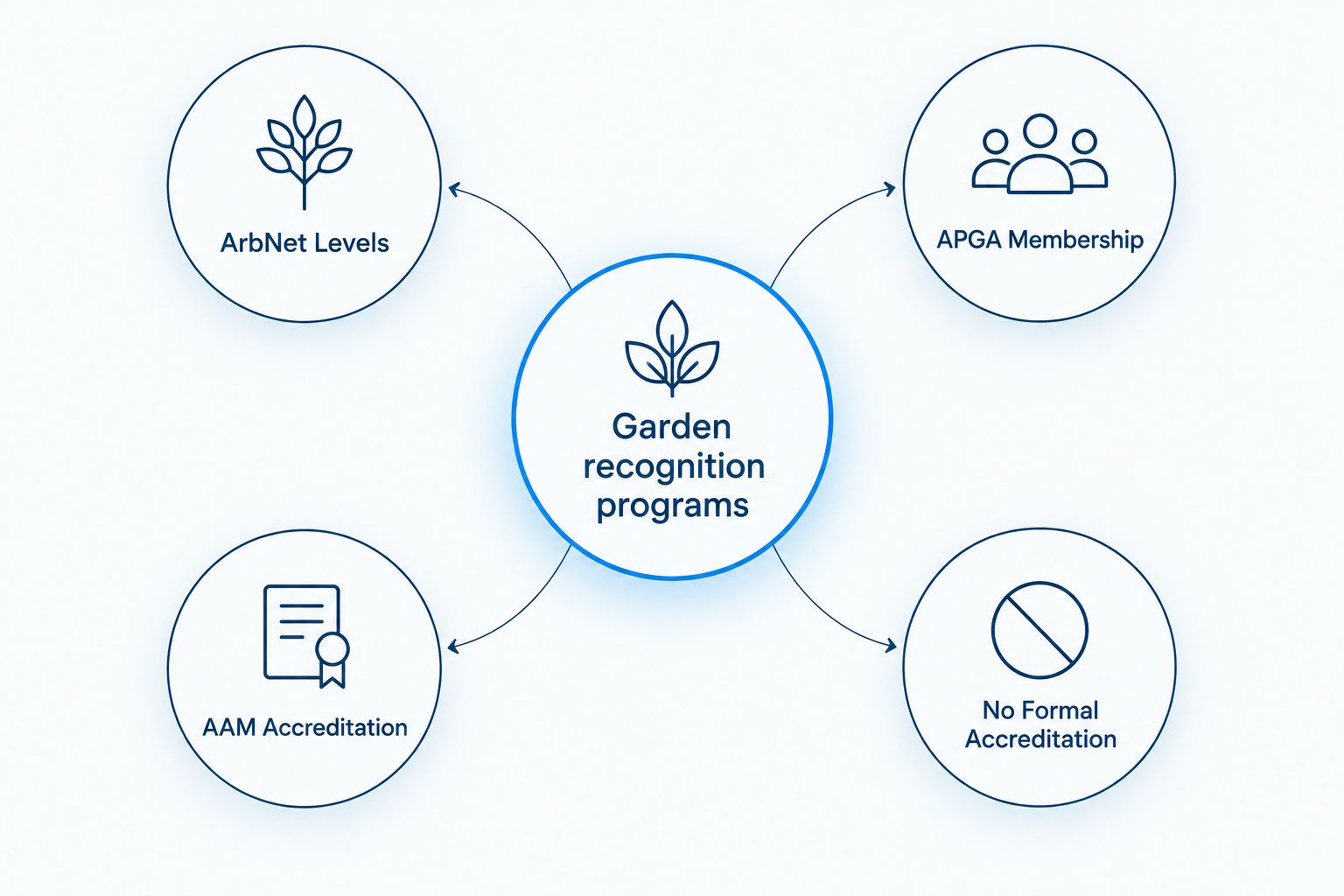
AGCA isn't a real accrediting body for botanical gardens in the US in 2026 — the initials don't correspond to any organization that certifies public gardens, so there's no published count of "AGCA accredited" botanical gardens because that credential simply doesn't exist. The systems people usually mean instead — ArbNet, American Public Gardens Association (APGA) membership, and American Alliance of Museums (AAM) accreditation — each measure something different, and none of them go by the name AGCA.
- No organization called AGCA accredits botanical gardens in 2026 — the acronym doesn't match a real program.
- ArbNet accredits arboreta and tree collections across four levels, and some botanical gardens qualify through their arboretum divisions.
- American Public Gardens Association (APGA) runs a membership network, not an accreditation program.
- American Alliance of Museums (AAM) accredits museums broadly, and a handful of public gardens with museum-caliber collections carry that credential instead.
- A botanical garden checklist tracker sidesteps the accreditation confusion by tracking visits by garden name, not by badge.
Why this matters
Garden marketing copy throws around the word "accredited" loosely, and if you're trying to plan a garden bucket list, that word can send you chasing a badge that doesn't back up anything real. Knowing which programs are legitimate and which are noise saves you time and helps you pick gardens based on their actual collections, not a certification that got invented somewhere along the way. A botanical garden checklist tracker works the same whether a garden is accredited by ArbNet, a member of APGA, or carries no credential at all — you're tracking the visit, not the paperwork.
How many botanical gardens are AGCA accredited in the US?
Zero, because AGCA isn't a real program — there's nothing to accredit against. Here's what the actual landscape of garden recognition programs looks like in 2026, compared side by side:
| Program | What it certifies | Who runs it | Best for |
|---|---|---|---|
| ArbNet Accreditation | Tree collections, arboreta, and garden divisions with formal woody plant collections | The Morton Arboretum's ArbNet network | Gardens with a documented tree collection |
| APGA Membership | Nothing formally vetted — it's a professional network, not a quality standard | American Public Gardens Association | Industry connections and shared resources, not proof of quality |
| AAM Accreditation | Museum operations broadly, evaluated across the institution, not the garden specifically | American Alliance of Museums | Public gardens with an attached museum wing or collection |
| "AGCA" | Nothing — no such accrediting body exists | N/A | Drop this search term; it won't lead anywhere useful |
If a garden's website claims "AGCA accredited," that's either a typo for one of the programs above or a marketing claim with no organization standing behind it. Worth double-checking before you build a trip around it.
Why there's no single accreditation number for botanical gardens
Unlike national parks, which get a federal designation from Congress, botanical gardens have no central government body deciding who counts and who doesn't. A few things drive the confusion:
- No federal registry exists — compare that to how many national parks are there, which is a fixed number set by law, not a moving target split across private organizations.
- Gardens self-select which network to join, if any — a garden can be ArbNet accredited, APGA member, AAM accredited, all three, or none, and each of those overlapping lists gets counted differently by different sources.
- Many respected gardens carry zero formal accreditation — college arboreta, city-run conservatories, and botanical societies often skip every program and still draw large crowds and strong reputations.
- Accreditation costs money and staff time — smaller nonprofit gardens frequently decide the application process isn't worth the resources, regardless of collection quality.
- The word "accredited" gets used loosely in garden marketing — travel bloggers and even garden staff sometimes misuse the term for what's actually just membership or a self-published award.
ArbNet's four accreditation levels explained
ArbNet is the closest thing to a real accreditation system that touches botanical gardens, though it's built for arboreta and tree collections specifically, not gardens as a whole category. The program runs on four levels:
- Level I — entry-level recognition for a documented tree collection with basic record-keeping in place.
- Level II — adds staffing requirements and a more developed plant records system.
- Level III — requires ongoing conservation, education programming, and a professional horticulture staff.
- Level IV — the top tier, reserved for institutions with research programs, extensive collections, and long-term institutional planning.
A botanical garden with a strong tree collection can hold an ArbNet level while never touching APGA or AAM at all — the three programs don't require each other, which is part of why nobody publishes one unified "accredited botanical gardens" count.
“If a garden calls itself AGCA accredited, ask which program they actually mean — the initials don't map to a real accrediting body.”
If you're planning visits around credentialed gardens versus hidden-gem gardens with no badge at all, a printable tracker handles both the same way. The botanical garden checklist for garden club members is built around visits and standout features rather than which accreditation logo sits on the homepage — useful since, as covered above, plenty of the best gardens in the country carry none.
Track your garden visits your way
Skip the accreditation confusion and log what you've actually seen.
How many botanical gardens are there in the US total?
There's no official government census of botanical gardens in the US, so any total you see floating around is an estimate from a single organization's membership rolls, not a definitive count. APGA's member list, ArbNet's participant list, and independent garden directories all use different definitions of what counts as a "botanical garden" versus an arboretum, conservatory, or public park with plantings — which is exactly why the numbers don't line up between sources.
Is American Public Gardens Association the same as AGCA?
No — American Public Gardens Association (APGA) runs a membership network for public garden professionals, and it's a completely different acronym from the nonexistent "AGCA." The mix-up usually comes from people mishearing or misremembering APGA's name and assuming it functions as an accrediting body, when in 2026 it's structured as an open professional membership, not a vetted certification.
How many arboretums are ArbNet accredited?
ArbNet doesn't publish one fixed public total because new arboreta apply and get approved on a rolling basis throughout the year. The network spans US and international institutions across all four accreditation levels, so any specific number quoted online is likely a snapshot that's already out of date by the time you read it.
FAQ
What does AGCA stand for in botanical gardens?
AGCA doesn't stand for a real botanical garden accreditation body in 2026 — no organization by that name certifies public gardens. It's likely a misremembering of ArbNet, APGA, or AAM.
How many botanical gardens are accredited in the US?
There's no single accredited-botanical-garden total because no unified accreditation system covers the category. ArbNet, APGA, and AAM each track a different, overlapping slice of gardens with no combined public count.
Is ArbNet the same as botanical garden accreditation?
ArbNet accredits arboreta and tree collections specifically, not botanical gardens as a whole category. A garden with a strong plant collection outside of trees can operate with zero ArbNet involvement.
Do botanical gardens need accreditation to open to the public?
No, most botanical gardens operate without any formal accreditation. City-run conservatories, university arboreta, and nonprofit gardens open to visitors regardless of credential status.
Which botanical gardens have AAM accreditation?
American Alliance of Museums accredits museum operations broadly, and a handful of public gardens with attached museum divisions hold that credential. It's a museum-wide standard, not a garden-specific one.
What's the best way to track botanical garden visits without an accreditation list?
A printable botanical garden checklist tracks visits by garden name and region instead of relying on an accreditation badge. That works whether the garden holds a credential or none at all.
Why do some garden websites claim AGCA accreditation?
It's usually a typo or confusion with ArbNet, APGA, or AAM rather than an intentional false claim. Worth verifying directly with the organization named before trusting the badge.
Is APGA membership worth checking before visiting a garden?
APGA membership signals a garden is connected to the professional public gardens community, but it's not a quality vetting process. Use it as one data point, not a deciding factor.
One last thing
Some of the most celebrated botanical gardens in the country — university arboreta especially — carry zero formal accreditation and still get ranked among the best gardens in America by garden clubs and travel writers year after year. The badge was never the point in 2026, and it wasn't the point before that either — the collection, the design, and what's blooming when you show up are what actually matter.